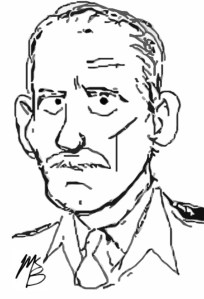
Lieutenant-Colonel Stanislaw Koszutski
2nd Armoured Regiment (Poland)
Under hellish fire from cannons and mortars, the 3rd Armoured Squadron supports and covers the first two … The guns were hot to the extreme for all the shots they fired and the crews were all but deaf from the explosions and choking on the smoke. However, it saved the lives of dozens of its colleagues who managed to jump out from the burning tanks. It can be proud of how it performed its task.
(Quoted in Zbigniew Mieczkowski, Horizons, 89)
Born on 15 August 1903 in Kielce region of Poland, Stanislaw Paweł Koszutski was a veteran of the Polish Legion, the Third Silesian uprising, and the Polish-Soviet War. He was commissioned a second lieutenant in the Polish Army in 1923 and rose through the ranks of the artillery branch. He was captured by the Soviets during the invasion of September 1939 but escaped to join the Polish forces in France and then England.
In September 1942, he succeeded Colonel Zygmunt Chabowski in command of the 2nd Armoured Regiment, which as part of the 1st Armoured Division. It landed in Normandy in July 1944, later to become part of II Canadian Corps. In Memories of Various Battlefield (1972), Koszutski described the unit’s first action at Caen on 8 August: “We emerged from a thick white milky fog into bright sunlight amidst the golden wheatfields of Normandy. We proceeded as if on parade, full of vigour and faith in our own strength to announce to the world that Poland had not yet fallen.” For actions on 8 September, he earned the D.S.O.:
The success of the operation was very largely due to Lieutenant Colonel Koszutski’s coolness and presence of mind under difficult conditions. He set a fine example to the men of his regiment by his determination and utter contempt for danger, and was an inspiration to all under his command. Exhibiting outstanding qualities of leadership.
He remained in command through the hard fighting in France, the Low Countries, and Germany until the end of the war. On 12 April 1945, his regiment liberated a camp holding 1,726 Polish girls and women of the Home Army from the Warsaw Uprising two years before. Koszutski wrote of the scene:
We enter the square of barracks. ‘What the hell, who is that?’ a tiny creature runs across. She is a very attractive young girl, dressed in a long military coat and wearing a cap displaying the Polish Eagle and the colours of the 7th Lancers.
“English, Francis, Americano, Canada sind Sie?” she shouts.
“Polish troops, Miss! The 1st Polished Armoured Division, darling!” the motorcyclist, Witkowski, answers.
“Poles, my God, Poles! And we are here from the Home Army from the Warsaw Rising! It’s a miracle! she shouts” and runs back to the camp.
My tank pushes the gates down and we suddenly find ourselves on the parade ground. All at once, the doors all open and we see women, like a hive of bees, running out wearing uniforms or rags of uniforms to surround us.
In their march ‘from foreign lands to Poland’, on entering Germany, they liberated heroic Warsaw women and, in many an instance, met their future wives and life companions. The isolated toils of the Warsaw Uprising were echoed by the cannons of Polish tanks on the Western front. The soldiers listened into the dying echoes of fighting from their homeland, clenched their teeth and despite being betrayed by the Allies, pledged bloody revenge.
(Quoted in Zbigniew Mieczkowski, Horizons, 106-107)
He relinquished command to Major Michal Gutowski before the end of April. After the war, Koszutski emigrated to Brazil, where he established his own motor parts factory. He died in Sao Paulo on 24 September 1982. One of his former soldiers, Zbigniew Mieczkowski, eulogized his former commanding officer:
It is next to impossible to do justice in an article such as this one to the full richness of the life of Koszutski — the callow youth full of unfettered bravado, the brave Staff Officer of a Cavalry unit in the September campaign, a great teacher and trainer and lecturer in modern warfare, a vibrant regiment commander, a writer endowed with much literary talent, humour and satire and finally a wealthy industrialist, philanthropist and benefactor. Perhaps this exceptional man shall one day become the subject of a literary essay.
 World War Graphic History