Lieutenant-Colonel Aleksander Stefanowicz
1st Armoured Regiment (Poland)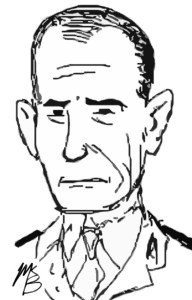
Gentlemen. Everything is lost. I do not believe the Canadians will manage to help us. We have only 110 men left, with 50 rounds per gun and 5 rounds per tank … Fight to the end! To surrender to the SS is senseless, you know it well. Gentlemen! Good luck – tonight, we will die for Poland and civilization. We will fight to the last platoon, to the last tank, then to the last man.
(Quoted in Roman Jarymowycz, Tank Tactics, 201)
Born on 20 December 1900 in Polewicze, Russian Empire, Aleksander Stefanowicz was a long-serving officer in the Polish Army. He joined in 1919 and fought with a cavalry regiment during the Polish-Soviet War. He was commissioned a second lieutenant in 1922, and after completing training courses on tank warfare, he became an instructor in the 1930s. After the German and Soviet invasions of Poland in September 1939, he went to France where he became adjutant to General Stanisław Maczek of 10th Armored Cavalry Brigade.
In a 1927 issue of Świat, an illustrated weekly magazine, Stefanowicz wrote an article about the history of armoured warfare and early development of tanks:
Since the World War, the term tank has been used to describe an armed, mechanically powered armoured vehicle equipped with tracks, which are endless rails, thanks to which the vehicle is able to move on modern battlefields, overcoming difficult terrain obstacles in the form of craters and ditches. Thanks to its armour and armament, such a vehicle is a powerful offensive means.
The idea of a tank as a combat vehicle is extremely old and dates back to ancient times, as Plutarch accuses Demetrius Poliorcetes, the conqueror of Greek cities, of using a type of caterpillar track, i.e. an endless chain, in the construction of a huge tower that was supposed to: “move over any terrain without noise or shaking due to the action of the service hidden inside it.”
After tracing the evolution of armoured fighting vehicles from chariots to the Renaissance designs of Leonardo di Vinci, Stefanowicz explained the use of tanks by the Allied armies in the First World War. Projecting to future conflicts, he concluded:
Based on the current development of tanks, one may assume, without entering the realm of too vivid imagination and not forgetting the realization of [H.G.] Wells’s very bold fantasies, that the future battlefields will see whole hosts of tanks, whose mutual fights will be similar to naval battles.
In November 1943, Stefanowicz took command of the 1st Armoured Regiment. In July, he led the regiment into Normandy as part of 1st Armoured Division under General Maczek. In August, the division went into action attached to II Canadian Corps. During the heavy fighting in the Falaise pocket, a German counterattack trapped his regiment. Fearing annihilation, Stefanowicz urged his troops to fight to the death, but they pushed back the German assault before being resupplied and relieved.
Stefanowicz remained in command through to the end of the war and earned the Distinguished Service Order for leadership during the hard fighting in the Low Countries and Germany:
By surprise he captured by a daring manoeuvre on 20th April 1945, in spite of strong enemy anti-tank defence, the Towns: Herbrum, Aschendorf the Tunxdoefen Wood and the Village Tunxdorf and Neundorf … Throughout the action Lieutenant Colonel Stefanowicz commanded personally moving always immediately behind his forward elements under enemy fire.
The above action resulted in 300 POWs being taken and 8 anti-tank guns liquidated
With the disbanding of the 1st Armoured Regiment in 1947, Stefanowicz joined the Polish Resettlement Corps, the organization formed by the British Government to demobilize veterans into civilian society. He immigrated to Canada in 1949 and worked in a department store. He died on 2 March 1985 in Toronto.
 World War Graphic History