Brigadier R.H. Beattie
Canadian Fusiliers (City of London)
13th & 14th Infantry Brigades
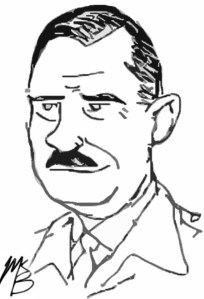
Whilst leading his company he was held up by an enemy machine-gun post. He, with a section, outflanked the post and then personally with great courage rushed it, shooting one of the enemy, taking prisoner another, and capturing a gun.
(M.C. citation, 3 Oct 1918)
Born on 30 September 1895 in London, Ontario, Russell Hilton Beattie was a decorated First World War veteran and militia officer. He went overseas as a lieutenant in the 135th Battalion and transferred to the 20th Battalion in France in February 1918. He was wounded in action during the Hundred Days’ Offensive but earned the Military Cross for conspicuous gallantry. After mobilization in September 1939, he served as chief recruiting officer for No. 1 Military District Southwestern Ontario) and barracks commandant in Windsor before taking a senior officers’ course at RMC.
By April 1942, Beattie had been promoted to lieutenant-colonel and appointed commanding officer of the Canadian Fusiliers (City of London) Regiment. In August 1943, he led the Fusiliers to Kiska Island as part of the 13th Infantry Brigade in the joint American-Canadian operation in the Aleutians. Anticipating a Japanese occupation, the landings instead confirmed that the enemy garrison had already left. In October, Beattie was recalled to Canada and promoted to brigadier of the 14th Brigade, 6th Division. Command of the regiment passed to Major R.E. Bricker, who had served overseas with the Highland Light Infantry.
In November 1944, with reinforcements urgently needed for the Canadian divisions in Europe, Major-General Reginald Pearkes of the 6th Division and his brigadiers held a press conference admitting that the plan to encourage home defence conscripts to volunteer for overseas service had failed. “I have in that brigade some of the finest soldiers in Canada,” Beattie stated. “They are just waiting the call from the Government that they must go, for they feel that it is the responsibility of the Government to implement its own legislation.”
The generals’ “revolt” against the Mackenzie King Government policy led to rumors of courts martial for this public insubordination, but national defence headquarters exonerated the group from any breach of regulations. In the end, the government sent a levy of 16,000 troops overseas, which provoked a short-lived soldier mutiny.
Beattie retired from the army in June 1945. He served as sheriff for Middlesex County for many years and died on 25 August 1977.
 World War Graphic History