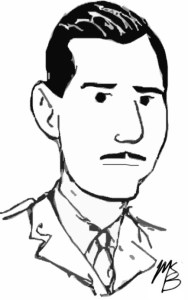
Major John A. Hebb
West Nova Scotia Regiment
The Churchill visit was undoubtedly more than a matter of courtesy … This suggests that he completely recognizes Canada’s status as a world power as well as her unique position as a link with the United States on the one hand and Britain and France on the other. It is quite conceivable too that one of his motives was to draw the attention of the world to Canada’s present importance.
(quoted in National Post, 26 Jan 1952, 7)
Born in Hebbville, Nova Scotia on 19 August 1910, John Alexander Hebb was an graduate of University of King’s College and instructor at King’s College School in Windsor. An officer in the Lunenburg Regiment since 1927 and member of the COTC at university he mobilized with the West Nova Scotia Regiment on the outbreak of war in 1939.
He served as a company commander then as second-in-command under Lieutenant-Colonel A.A. Ernst. Although Ernst had performed well on a senior officers’ course, he failed to impress General Bernard Montgomery on an inspection tour in February 1942. Montgomery thought Ernst slow to follow instructions and required much guidance. He found that the whole battalion “gave me an uncomfortable feeling from the start.” A month later Ernst was gone, replaced by Major Hebb, one of the only West Novas who impressed Monty.
Hebb served as acting commanding officer until July 1942, when he was succeeded by Lieutenant-Colonel Pat Bogert, who had been attached to the British Army in the Libyan campaign. Hebb was assigned to instructional duties at military training schools. After the war, he worked at Dalhousie University before a tenure as headmaster at King’s College School from 1947 to 1952.
He died in Hebbville on 23 November 1999.
 World War Graphic History