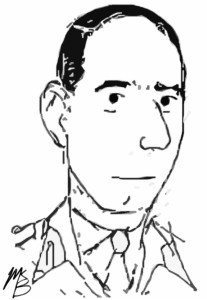
Brigadier James Roberts
12th Manitoba Dragoons
8th Infantry Brigade
The commanding officer looks on the patrol not as a sergeant and three men, but as the sons or brothers of men he knows well at home, and he doesn’t want to commit some good boys from his or an adjoining town to a mission which may cost them their lives. While any decent person may sympathize with the commanding officer’s view, it simply won’t work in war. For one thing, a commander must be completely impartial and he must obey, with understanding, his superior’s orders.
(Roberts, Canadian Summer, 103)
Born in Toronto on 19 August 1907, James Alan Roberts was a University of Toronto graduate, hockey player and employee of the Sun Insurance Company. After two years working at the New York branch he returned to Toronto where he took a commission with the Governor General Horse Guards in 1933. By the late 1930s, he worked with his brother to start an ice cream business in Scotland. With this venture derailed by the outbreak of war in Europe, Roberts returned to Canada to volunteer in the army.
In his memoir, Canadian Summer, Robert described this period
April 1940, marks the end of the most changeable and frustrating part of my life. The previous fifteen years included many happy times but also long periods when my career hopes were almost never realized. Even a simple, established business position, sufficiently well paid to enable me, and my wife, to live a modestly comfortable life, seemed never to materialize – and, after ‘Snow Cream,’ the future held only the promise of war.
He mobilized for active service with the Toronto Scottish before transferring to the Royal Canadian Dragoons. Within only a few years he was a major and the regiment’s second-in-command. “By this promotion I had been advanced,” he wrote, “in one jump, over the heads of all the permanent force officers in the regiment as well as the younger officers with whom I had served since joining the unit.”
While the RCDs would soon deployed to Sicily in summer 1943, in May, Roberts became second-in-command of the 18th Armoured Car Regiment (12th Manitoba Dragoons). He succeeded Lieutenant-Colonel Bob Moncel in command in August 1943. Roberts described his leadership philosophy:
I knew every man in the regiment by name and I made a practice of speaking to all ranks, as a whole, as often as possible. I told them frankly what I was trying to do, why it was important, and, within the limits of security, forecast to them my view of our future employment and, particularly, how I felt they should operate as small and independent units in battle.
Roberts led the regiment to France in July 1944 as part of the 4th Armoured Division. He wrote of his first experience under German artillery fire:
It is amazing how quickly the soldier becomes used to noise and danger, which does not mean that he learns to like it. However, this very first action position, although a relatively quiet one, answered for me a question which I had often posed to myself during training days, that is, ‘How will I behave under fire? Will I act in a cowardly or frightened way?’ This is a question every soldier asks himself before battle. Our experience under fire, or in close contact with the enemy, then and later, made it crystal clear that each soldier, no matter what his rank, is deeply influenced by the presence of his comrades and knows in his heart that he must behave in a calm and courageous manner in order to retain the respect of his fellow soldiers. This simple truth is of the greatest importance, it is the foundation of discipline, and it applies even more strongly to senior ranks who bear the burden of responsibility to command.
After hard fighting in Falaise and the Low Countries, Roberts was appointed to assume command of 8th Infantry Brigade from Lieutenant-Colonel P.C. Khalen, who had temporarily taken over after the death of acting Brigadier T.C. Lewis on 17 October 1944. Major P.C.R. Black assumed command of the 18th Canadian Armoured Car Regiment. “The time has come, when temporarily at least, we must part,” Robert announced in the unit bulletin, The Staghound, “I am called to other duties, but I leave, happy in the knowledge that the Regiment has found itself, and it’s place in the history of this war is assured by its own efforts.”
After being bogged down under mortar fire in a forward position with 8th Brigade, Roberts quickly learned the responsibilities of higher command:
Perhaps, in older days, success in battle required that the senior commander lead the charge of his unit, in the gallant fashion of Waterloo. But not today. I am not being categoric about the principle of method of command. There may be occasions when only the appearance of the senior commander can rally his troops to hold a line or to overrun an enemy. But, the basic principle remains that the senior commander should place himself, during an operation, in the position from which he can best influence the battle. This simple dictum usually means that he remains, during battle, at his battle hq where he has the maps and the wireless equipment to control his brigade, can call up reserves, request additional artillery or tank support at a critical moment, and so forth.
Roberts commanded the 8th Brigade until the end of the war and the German surrender in the Netherlands. Before demobilization, he served on the court martial that convicted Kurt Meyer of war crimes for permitting the murder of prisoners in Normandy. After the war, Roberts went on to a career in business, civil service, and diplomacy. He served as Deputy Secretary-General of NATO from 1964 to 1968 and then as Canada’s ambassador to Switzerland.
Roberts died on 19 February 1990 in Lymington, England.
 World War Graphic History