Brigadier Hugh Young
6th Infantry Brigade
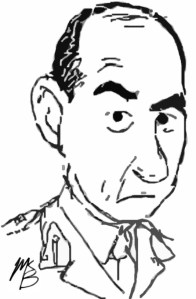
I have only been on the ranges twice and have never had a musketry course. Previous to enlisting I was going to high school in Winnipeg. I have always lived in the city and had no experience whatever with firearms. This was my first trip in the line and I was very nervous, being anxious to conduct myself properly. Thus, in the hurry and excitement of an ordered stand to, I had the accident … I deeply regret the accident.
(FGCM of Pte. H.A. Young, 27 Feb 1918)
Born on 3 April 1898 in Winnipeg, Hugh Andrew Young enlisted in the 251st Battalion in November 1916 and joined the 44th Battalion on the front in January 1918. Within two months, he was court martialled for negligently wounding a comrade, Private Ralph Thorpe, who died weeks later. Although his platoon sergeant testified that the shooting was “purely accidental” when Young was cleaning his rifle, the nineteen-year-old was sentenced to forty-two days field punishment No. 1.
Young was wounded in July 1918 and ended the war at the rank of corporal. After the war, he finished high school and graduated from University of Manitoba with a degree in electrical engineering in 1924. He then rejoined the army with a commission in the Royal Canadian Signals Corps and served in the Arctic.
Following the outbreak of war in 1939, he was attached to Canadian Military Headquarters in London. Following chief of staff postings to 2nd Division, 5th Division, and II Canadian Corps, he was appointed commanding officer of 6th Infantry Brigade in February 1944. He remained in command through the invasion of France until the operational failure at Verrières Ridge in late July 1944.
Young blamed subordinate commanders and filed an adverse report against Lieutenant-Colonel B.J.S. MacDonald of the Essex Scottish, claiming that he had panicked and lost control of the situation. MacDonald defended his actions after being removed from command:
I was indignant at the lack of tank support, the casualties from artillery fire, the lack of food and drink … I felt that unless something could be done, we would have difficulty in resisting any determined counterattack … [Young] was apparently not suffering from any of these physical discomforts or worries and was very composed. He refused to see that anything was wrong, or that I had any basis for my complaint and misgivings respecting support …
My feelings were less nervous than frustration and suppressed anger at his impatient attitude toward me and my inability to move him.
By the end of August 1944, Young was removed from the field as well, but he was promoted to major-general and appointed army quartermaster general back in Canada. Despite the controversy over his leadership, he received the D.S.O.:
Appreciating the importance of maintaining cohesion amongst foremost troops, and that his, and that his troops were fighting in their first major action, Brig. Young, without regard to his personal safety and heavy machine gun, mortar and artillery fire, visited forward battalions and companies and personally supervised the redisposition of units to ensure that counter attacks were repelled and a front established.
When his Brigade Major was killed and another of his General Staff Officers was wounded, Brig Young, with little assistance, continued to direct the battle from forward position until it was successfully concluded on 26th July, 1944.
By his personal courage, determination, endurance and example he so impressed the officers and men of the brigade that the attack was relentlessly pressed home and St-Andre-Sur-Orne was captured despite the bitter resistance.
“We are dealing with three distinct types of Germans,” he told the press on reporting home. “First, the young Nazi fanatics—lads from 15 to 28—who will fight to the last bullet and will then bite and scratch and scream. Second, the old German soldier, a typical finely-trained battler who will fight until he sees himself outnumbered, and third, the armies formed of Russians, Poles and Sudetenland Germans. The latter quit before they get started.”
After a long postwar career in the civil service, Young died in Ottawa on 21 January 1982.
 World War Graphic History