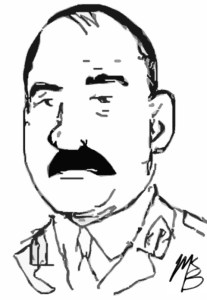
Brigadier Bob Wyman
1st & 2nd Armoured Brigades
Everything I have seen since I have arrived home gives new reason for this fight. There is freedom here and greener fields and even fatter cattle. You notice these things after being in Britain and they are not imaginary. They are the things we hold dear and things that most Britons cannot enjoy under war conditions.
(Quoted in Edmonton Journal, 18 Jun 1941, 1)
Born to Canadian parents in Philadelphia on 23 February 1904, Robert Andrew Wyman was a Canadian Nation Railway statistician in Edmonton and a militia officer since 1923. He mobilized as commanding officer of an artillery regiment and went overseas with the 1st Canadian Division in December 1939. After a promotion to brigadier in May 1941, he returned to Canada to organize the 1st Canadian Support Group.
“There is nothing but the greatest confidence that the Allies will win,” he reported to the press shortly after arrival at home. “They go about daily tasks just hours after devastating air attacks and in every way show they are prepared for the worst that ‘Jerry’ can hand out and then go on to win.”
By Mach 1942, he was back overseas in command of the 1st Tank Brigade, succeeding General F.F. Worthington. The formation, which consisted of the 11th Armoured Regiment (Ontario Regiment), 12th Armoured Regiment (Three Rivers Regiment), and 14th Armoured Regiment (Calgary Regiment), would be redesignated the 1st Canadian Armoured Brigade shortly after the invasion of Sicily and Italy in August 1943.
Wyman commanded the brigade in the Mediterranean theatre until February 1944 when he was recalled to England to take over the 2nd Canadian Armoured Brigade, comprising 6th Armoured Regiment (1st Hussars), 10th Armoured Regiment (Fort Garry Horse), and 27th Armoured Regiment (Sherbrooke Fusilier Regiment), which four months later participated in the invasion of France.
After being wounded in the Falaise operation in August 1944, Wyman was invalided to Canada and replaced by Brigadier J.F. Bingham. “There has never been, either in this war or the First Great War, a finer soldier to take the field of battle,” he declared of Canadian troops on arrival home in October.
Ending the war with the DSO and CMB, Wyman retired from the army in 1945 and resumed his career with CNR. He died in Vancouver on 23 March 1967.
 World War Graphic History