Lieutenant-General Charlie Foulkes
3rd Infantry Brigade
2nd Canadian Division
II Canadian Corps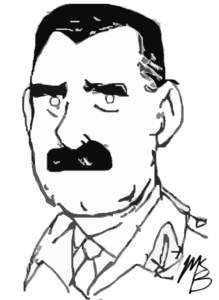
I have come to the conclusion that attempts to limit the use of force by banning certain types of weapons or by partial disarmament including all types of nuclear weapons, does not appear to be the right answer to this dilemma. I take issue with those who say let us go back to conventional weapons, as if it was all right to settle disputes by conventional means when only soldiery get killed but the world is saved from destruction.
(National Post, 9 Mar 1963, 6)
Born on 3 January 1903 in Stockton-on-Tees, England, Charles Foulkes grew up in London, Ontario and joined the Royal Canadian Regiment after graduating from Western University in 1926. Following staff posts to militia district headquarters in Toronto and Kingston, he attended staff college at Camberley, England. At the outbreak of war in 1939, he was appointed brigade major when the 1st Division went overseas in December 1939. By September 1940, he was back in Canada as general staff officer for the newly formed 3rd Canadian Division.
Foulkes returned overseas with the division in July 1941 and with a promotion to brigadier took command of 3rd Infantry Brigade a year later. He returned to staff duties with First Canadian Army in April 1943 before being appointed major-general of 2nd Canadian Division in January 1944. He commanded the division throughout the Normandy campaign, but uneven performance and uninspired leadership meant he felt his position was unsecure especially under General Guy Simonds who frequently sacked senior officers. General George Kitching of 4th Armoured Division recalled Simonds spoke about getting rid of Foulkes in July but never did. He suspected the influence of General Harry Crerar. Instead, Simonds removed Kitching in August.
In fall 1944, when Simonds temporarily commanded First Canadian Army in the absence of Crerar, Foulkes became acting commander of II Canadian Corps. In November, despite an average record in Normandy, Foulkes was promoted to take over I Canadian Corps in Italy from E.L.M. Burns. Initial miscommunication over the similarly pronounced names, led Major-General Chris Vokes to assume the appointment was his. With mutual hostility between the generals, Vokes was transferred to Northwest Europe in command of 4th Division rather than serve under Foulkes.
Kitching who had recently arrived in Italy to be chief of staff at Corps headquarters, recalled: “I had nothing against Charles Foulkes but I felt that to promote him at this time was Army politics of the worst kind … I could not help but feel that this was General Crerar at his worst. He did not want Simonds or Vokes to be Chief of the General Staff after the war; they both had strong opinions and personalities. Charles Foulkes would be more amendable to the politicians.”
Kitching felt Foulkes did little to endear himself to his subordinate commanders under a difficult circumstance but came to respect his tactical abilities. “I often wondered why General Simonds had such a poor opinion of him in our early days in Normandy because the more I worked with Charles Foulkes in Italy the more I respected his judgment in tactical matters, and I know that the staff at Corps and the Divisional Commanders had the same confidence.”
In February 1945, I Canadian Corps moved to the Northwest European theatre. In May, Foulkes and Kitching accepted the unconditional German surrender in occupied Netherlands. After the war, Foulkes became Chief of the General Staff from 1945 to 1951 and then took on the new post of Chairman of the Chiefs of Staff Committee from 1951 to 1960. His long tenure exerted a strong influence over the direction of Canadian defence policy in the Cold War years.
He died in Ottawa on 12 September 1969.
 World War Graphic History