Lieutenant-General Tommy Burns
4th Armoured Brigade
2nd & 5th Canadian Divisions
II Canadian Corps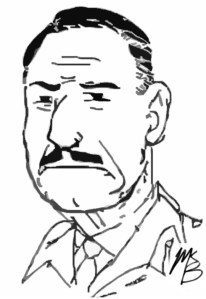
Having thus confronted death, and learned that its presence does not paralyze, and having known that while fear may clutch, it does not necessarily strangle, I feel that I am a happier man. I reason (perhaps fatuously), What am I likely to experience that will be harder to bear than that which I have borne?
(Arlington B. Conway, “In Praise of War,” 1927, 391)
Born in Montreal on 17 June 1897, Eedson Louis Millard Burns graduated from the Royal Military College in 1914 and took a commission in the Canadian Engineers. He served as a staff officer in the 3rd Division in France where he was twice wounded and earned the Military Cross. In the 1920s, he worked as an instructor at RMC while continuing his own professional staff officer education. During the interwar, he wrote several articles on military science and defence issues as well as contributions to American Mercury under a pen name, “Arlington B. Conway.”
During the early years of Second World War, he served on the general staff of Canadian Military Headquarters in London until his career was checked by violations of press censors. He had disclosed careless opinions about military personnel in letters to his mistress, which led to his return to Canada in May 1941.
Personal indiscretions aside, he returned to high rank with a promotion to brigadier in February 1942. He commanded 4th Armoured Brigade until May 1943 when he was promoted again to major-general of 2nd Canadian Division. In January 1944, he finally entered a combat theatre when he succeeded General Guy Simonds of 5th Armoured Division in Italy. Brigadier George Kitching, commanding officer of 11th Infantry Brigade, recalled:
As I got to know him better I realized that Tommy was not only a quiet man but that he had great difficulty when trying to encourage and enthuse any large group of men. He just could not ‘sparkle’ and continued speaking in the same tone of voice whether he was talking about a victory or a defeat. His nickname was ‘‘Smiler’’ because he had the reputation of never smiling although, when in conversation with friends, he seemed to smile as much as anyone else. But I must confess I never heard him let go a real belly laugh!
Although he had been in the Mediterranean theatre for only a short time, in March 1944, Burns succeeded General Harry Crerar as commanding officer of I Canadian Corps. Unpopular with British generals, and uninspiring for his men, Burns’s tenure was contentious even as the Corps experienced success on the battlefield. After eight months, he was replaced by Major-General Charles Foulkes formerly of 2nd Division in North West Europe. In November 1944, Kitching, who had returned to Italy to be chief of staff at Corps after being sacked from 4th Armoured Division in Normandy, lamented his brief reunion with the soon to be replaced Burns:
I felt very sorry for Tommy Burns. Having been away from the Italian front for eight months I was out of touch with command problems that might have arisen. But I am quite sure that Burns did not know he was about to be fired when he and I had talked only two days earlier.
Burns reverted to major-general and took up a posting in with 21st Army Group Northwest Europe. After the war, he became deputy veterans affairs minister and later served as a diplomat in the Middle East. During the Suez Crisis of 1956, he commanded the first United Nations peacekeeping force. Into the 1960s, he worked on disarmament and strategic studies, and published several books in the 1970s, including his memoir, General Mud.
Burns died on 13 September 1985 in Manotick, Ontario.
 World War Graphic History