Lieutenant-Colonel Dave Stewart
Argyll and Sutherland Highlanders of Canada
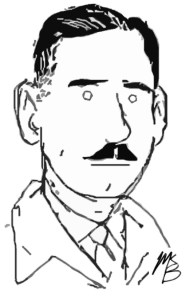
I was concerned when I got into battle that I would be able to stand it. I was; it didn’t bother me too much, and I was able to stand it very well. There was a rule that in action, steel helmets had to be worn. I adhered to it, except for myself where I figured that the psychological effect of my going around with the shells flying and my wearing a soft hat, would be great for morale, and it was.
(Quoted in Robert L. Fraser, Black Yesterdays)
Born on 21 August 1909 in Georgetown, Prince Edward Island, John David Stewart was a businessman and member of the Prince Edward Island Highlanders since 1928. On mobilization in 1939, he transferred to the North Nova Scotia Highlanders, went overseas as major and company commander in July 1941. and became second-in-command a year later. On September 1943 he was appointed commanding officer of the Argyll and Sutherland Highlanders of Canada, succeeding Major A.J. Hay who had taken the battalion overseas two months earlier.
The battalion adjutant recalled that A&S Highlanders embraced the new maritime CO: “Right from the start, everybody liked him. Everybody liked him. He won us all over in ten minutes. He had great charm and he was very decisive. Awfully nice guy. We just thought he was great.” His calm and professional manner impressed officers and soldiers alike. Stewart’s ambition was simple: to make “it the best battalion in the Brigade, and the best in the army. The best officers, the best other ranks and the best fighters.”
The Highlanders deployed to France with the 10th Infantry Brigade in July 1944. He served almost continuously for the next six months through the heavy fighting out of France into the Low Countries. “I was always up front,” Stewart explained of his command style, “you can’t win battles being behind. You’ve got to be there.” For his temporary brigade command in September 1944 he earned the Distinguished Service Order: “During this phase of the op Lt-Col Stewart was constantly with the tps at the brhead working under intense mortar and shell fire, and his calm, fearless direction of the op was an inspiration to all ranks.”
By the end of January 1945, he realized he was suffering from battle exhaustion and requested relief from command. With their former CO admitted to hospital, the Highlanders would soon be under the command of Lieutenant-Colonel F.E. Wigle. Sent back to England, Stewart appeared before a reclassification board in March. The senior officers described him as “medium build, neat clean-cut appearance, quite smart mil bearing … As far as the laymen can discern he shows no signs of instability or nervousness.” The report read in part:
Lt-Col. Stewart impressed the Board as a sound, sensible and capable offr with a good and keen sense of responsibility. He felt that he was slipping somewhat and was not as good a CO as he had been in the past due to the strain he had undergone. It was with this in mind that he approached his Bde Comd, expecting that his action would result in a Change of Employment report and was quite disconcerted when he learned that the report was headed up as an Adverse Report.
The board found no basis for a negative classification but determined “this offr is still very tense and will not be fit for combat duty again.” In a letter over a year later, Stewart reflected on his wartime experience:
Looking back, and your book certainly took me right back, I was an old softie at heart, I think I could take it but I had to force myself to hand it out. I always figured I had two enemies, the hun and Bde and Div (Our own) and I feel sure now that I did at least as well out figuring the latter as fighting the former. The fact that well than less than half the casualties were incurred in my six months of office imply something …
I was blessed with one of the finest collection of officers that any C.O. could have, but it hurts me to think of so many that are under the soil of Europe, it also hurts me that I am not living closer to those of you who are back so that we might continue the fine friendship formed under difficult conditions.
Stewart returned to Prince Edward Island, where he was elected a Charlottetown city councillor in 1951. Son of the former provincial premier, Stewart served in the PEI legislature as a Progressive Conservative from 1960 to 1970.
He died in Charlottetown on 5 December 1988.
 World War Graphic History