Lieutenant-Colonel Ian Sinclair
Argyll and Sutherland Highlanders of Canada
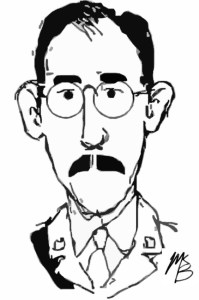
I thought my nerves might give if I ever ran into an affair of that sort, but something seemed to change in me and I saw without any particular sensation things happen, which in my previous state of mind would have driven me mad. One of my men actually did go crazy this morning after we got out. Every battalion in the division suffered about as much and the whole is pretty wrecked.
(Sinclair to mother, 28 Apr 1915)
Born in Toronto on 16 June 1891, Ian MacIntosh Roe Sinclair was a decorated First World War veteran, four times wounded in action, twice mentioned in dispatches and awarded the Distinguished Service Order and the Military Cross. He had sailed for England as a subaltern with the 13th Battalion in October 1914. Almost five years later, he returned to Canada at the head of that battalion. He became temporary commanding officer during the fighting at Canal du Nord in September/October 1918, and then again from February 1919 until demobilization.
As a student at the University of Toronto and member of the Queen’s Own Rifles. Sinclair had joined the 48th Highlanders at the outbreak of the Great War. During his brief time attached to the 15th Battalion, he had been especially unimpressed with the quality of his commanding officer, Lieutenant-Colonel John Allister Currie:
As was the case to be in many Canadian battalions, Lt/Col Currie was an M.P. and very much more of a politician than an officer … He was one of the type of civilian-soldier who is simply worshipped by the poorer element among the ranks, but to serve under whom, for an officer, is sheer misery.
Before the 1st Division embarked for England, Sinclair transferred to the 13th Battalion (Royal Highlanders of Canada). He was wounded at the second battle of Ypres but would be promoted to company commander. In 1917 he earned the Military Cross:
For conspicuous gallantry and devotion to duty. In the face of strong opposition he led his company to the final objective, and throughout the day, by personal observation, continue to send back such valuable information that our artillery was enabled to break up hostile counterattacks before they developed. The success of the operation was largely due to his personal efforts.
After Lieutenant-Colonel Eric McCuaig took command of 12th Infantry Brigade on 14 September 1918, Sinclair became temporary commanding officer of the 13th Battalion, earning the D.S.O.:
For sound tactical judgment and conspicuous gallantry tin the handling of his battalion at the Canal du Nord on 27 September 1918. The canal crossing had to be made on a 500 yard front, which was swept by machine-gun fire from Lock 3. Pushing forward, he established his headquarters close to the front line objective by another battalion and finally in conjunction with them succeeded in capture the village of Marquion and his final objective.
After the war, Sinclair pursued various business interests in Toronto and became commanding officer of the 48th Highlanders from 1930 to 1932. With the outbreak of the Second World War, he organized recruitment efforts at the University of Toronto. In August 1941, he succeeded Lieutenant-Colonel T.W. Greenfield of the Argyll and Sutherland Highlanders of Canada, just prior to the unit embarking for garrison duty in Jamaica. After almost twenty months on the island, the battalion returned home in preparation for overseas deployment.
Of the return voyage Sinclair related to the press:
I didn’t tell the men then—and most of them don’t know yet—but we were attacked by a submarine which fired a torpedo. We were around 300 miles west of Jamacia and it was very dark. Suddenly some other officers and myself saw a torpedo coming in our direction, but it missed us by a mile … maybe not a mile, but 50 yards, anyway.
(Toronto Star, 27 May 1943, 1)
In July 1943, he relinquished command of the A&S Highlanders to Major A.J. Hay, who took the battalion to the United Kingdom the next month. Sinclair was appointed provost marshal for Military District No. 2 (Toronto) and retired from the army in 1946, after being made Officer of the Order of the British Empire.
He died in Toronto on 5 September 1981.
 World War Graphic History