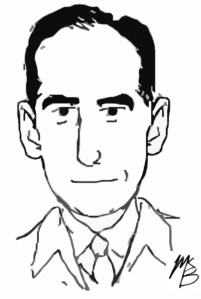
Major Leo Troy
Algonquin Regiment
In every lane, park and woodland you could see tanks, track to track, bullbozers, trucks, armoured cars, stretching for miles and miles. There was such an incredible amount of equipment you would think the little island would sink under its weight. And behind the vehicles was stored the greatest amount of ammunition in the world’s history, more than was used in the entire First Great War, and all in preparation for the invasion.
(Quoted in North Bay Nugget, 16 Oct 1945)
Born on 29 October 1894 in Chatham, New Brunswick, Martin Leo Troy was a physical education teacher and coach in North Bay, Ontario. A First World War veteran, he had served overseas with the Canadian Cyclists and remained active in the postwar militia. He helped to recruit the Algonquin Regiment and mobilized as “B” Company commander in 1940. He organized battalion sports and succeeded Lieutenant-Colonel J.B. Stewart before it embarked overseas in June 1943.
Two months after arrival in England, Troy relinquished command to Lieutenant-Colonel G.P. Henderson, who had recent returned from operations in Sicily. He stayed on as second-in-command until November 1943, when Troy joined the general staff of 3rd Division. He later served with First Canadian Army headquarters during the Northwest Europe campaign. Describing the buildup to D-Day, Troy explained:
It was incredible that it went forward without interference, and wonderful too, because if anything had happened to forestall the invasion, there is no telling what might have happened, and I think it would have been fatal to the morale of the men. Looking back, it is hard to believe that it was all possible … It made you proud to feel you were part of that glorious force … “Then they did what Napoleon had tried, arid Hitler was afraid to do, they invaded. By six hours after H -Hour of D-Day 500 square miles of beachhead had been secured and the portals had been breached.
After almost two and a half years overseas, Troy returned to North Bay in October 1945. “I see vacancies among the ranks of our young men,” he said on arriving home, “vacancies which will never be filled. I hope all the people of North Bay and all the people of Canada will never, never forget to appreciate what these boys have given.” He returned to teaching and physical education until thee 1959 Ontario election when he became Liberal member for Nipissing. He was re-elected in 1963 but died in office on 26 June 1965.
 World War Graphic History