Lieutenant-Colonel Jack McQueen
2nd Canadian Parachute Battalion
Lincoln and Welland Regiment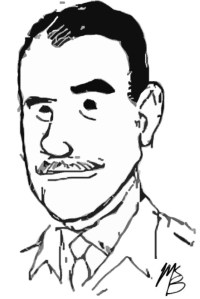
He looked like a real soldier, but he was one of the yellowest men in the army … But a regiment is only as good as its leaders, and out leader, Colonel McQueen, was simply no good. A good peacetime soldier and a disciplinarian, but he didn’t have the guts of a rabbit. And he could not plan a battle and carry it out. At Butcher Hill, he got down in a hole and would not come out … When we came down off the hill, he kept right on going, and we were all glad to see the end of him.
(Charles D. Kipp, Because We Are Canadians, 58)
Born on 7 July 1913 in Medicine Hat, Alberta, John Grant McQueen was supervisor with the Dominion youth training program and member of the South Alberta Regiment since 1927. Commissioned in 1935, he volunteered with the Calgary Regiment on the outbreak of the Second World War. In July 1942, he was recalled from the United Kingdom to join the joint Canadian-American 1st Special Service Force then training in Montana.
Promoted to lieutenant-colonel, McQueen took command of the regiment’s 2nd Canadian Parachute Battalion. “It’s new, it’s different. Of course I’m thrilled,” he stated although he suffered a broken ankle on his first parachute jump. McQueen remained undeterred, noting, “It must be realized that in this type of training casualties are bound to occur.” He was reassigned to be representative to the US War Department in Washington for planning of the unrealized Project Plough, an American and Canadian operation designed for Norway.
In January 1944, McQueen was back overseas and appointed commanding officer of the Lincoln and Welland Regiment, succeeding Major J.F. Madill. “He was a fine-looking soldier, a strict disciplinarian and training officer,” Sergeant Charles D. Kipp recalled, “but otherwise, just no damn good, as we learned later, much to our sorrow.” The battalion deployed to Normandy with the 10th Infantry Brigade over six months later at the end of July. Kipp claimed McQueen panicked in their first battle and had ordered the men to take cover before a German counterattack which never came. “This was the first of many mistakes made by Lieutenant Colonel McQueen,” Kipp criticized in his memoir, “In our first fight, we had taken a terrible beating over that blunder. And I never even got to fire my gun.”
After a failed assault, Kipp wrote, “McQueen blamed it on the men and officers. He said he was observing, and that we hadn’t even tried. He was observing from two miles behind us, and in the dark.” During one fierce fight, Kipp all but denounced McQueen as a coward:
But to make matters worse, our commanding officer, the colonel, got down in a hole and refused to come out. Someone else, one of the company commanders, had to take over control of the regiment. After we got off Butcher Hill, we never saw that colonel again. After Paris was freed, he was sent there and given a staff job as the head Canadian in Paris. I guess it paid to be yellow.
Regardless of the accuracy of Kipp’s perceptions, after one month in action, McQueen was relieved at the end of August. Brigadier J.C. Jefferson filed a confidential report stating: “This officer has lost the confidence of his subordinate commanders by his inability under battle conditions to plan quickly and issue firm determined verbal orders.” He was replaced by Lieutenant-Colonel W.T. Cromb, a veteran from the Italian campaign and second-in-command of the Argyll and Sutherland Highlanders. McQueen ended the war on the military staff in Paris and led a parade of British troops in the city after VE-Day.
The French government awarded him the Legion of Honor and Croix de Guerre, while the US Army gave him the Bronze Star:
His keen judgement and interest reflect great credit upon himself and the Canadian armed forces and have been of material assistance to the United States Army in accomplishment of its mission.
McQueen next served as deputy to General Maurice Pope, head of the Canadian Military Mission in Berlin. “Again in John McQueen I had an invaluable deputy,” Pope recalled. “Easily one of the most popular men in the English-speaking sectors of Berlin, he brought me many a nugget of information dug out from the lower levels, which would not have been available to me higher up the slope.” McQueen returned to Canada in January 1948. “I was more than sorry to see him go.” Pope wrote in his memoir. “During the two years he had been with me his support had been invaluable. A fine figure of a man, whose winning personality made him everywhere a great favourite, he had helped me in innumerable ways and much of the success that had attended our efforts was due to his good judgment and unflagging attention to business.”
McQueen’ applied for a position in the postwar Permanent Force but, the chairman of officer selection committee determined that the 1944 confidential report and seeming unfitness for command in the field, “to a certain extent limits his usefulness.” He retired from the army in 1947 and performed civil defence duties in Alberta. In civilian life, he headed the province’s motor association and by the 1960s he had moved to Ontario where he worked as secretary-general for the Canadian Automobile Association.
He died in Ottawa on 10 July 1990.
 World War Graphic History