Lieutenant-Colonel R.S.W. Fordham
Lincoln and Welland Regiment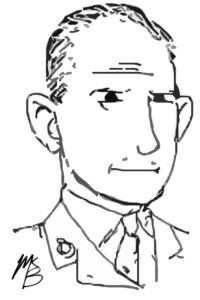
It is sometimes extremely difficult to make certain Refugees comfortable and happy in any sense of the words, as instance occur where they seem anxious to find fault and complain … Actually, many changes have been made of late for the benefit of Refugees, and it is probably correct to say that nowhere are they treated better than in Canada.
(Fordham quoted in Eric Koch, Deemed Suspect, 216)
Born on 9 May 1897 in London, England, Reginald Sydney Walter Fordham was a lawyer in Niagara Falls and a First World War veteran. He had joined the 98th Battalion as a lieutenant in December 1915 and joined the 13th Battalion in France at the end of September 1916. Less than two weeks later he went missing in action and spent almost the next two years a prisoner of war. He returned to law practice after the war and in July 1936 became commanding officer of the Lincoln and Welland Regiment.
He relinquished command to Major C.A. Muir in June 1940 before the battalion mobilized for active service that summer. A prisoner in Germany during the last war, Fordham became co-director of internment camps in Ontario and Quebec then became commissioner of refugee camps. “To him it was a military camp,” one official recalled. “Here this group of nervous, excitable people who felt they were being mistreated and this was a psychology he didn’t understand.” Under Fordham’s direction, thousands of internees, refugees and prisoners of war were eventually put to work for the war effort.
Eric Koch, a German Jewish refugee deported from England in 1940, recalled the friction between Fordham and internees over their civil rights. “No doubt he tried hard to do his job, but being a lawyer, he was skeptical about our repeated protestations of innocence and loyalty,” Koch wrote in his memoir, Deemed Suspect: A Wartime Blunder (1980). When Fordham refused appeals from Jewish refugees to transfer Nazi sympathizers to other camps, Koch explained:
He was not a professional soldier, inexperienced in civilian and political affairs, but a successful lawyer of some sophistication. Those who remember him would not call him insensitive to the sufferings of individuals. Did he really believe that this was a matter of civil rights, that the civil rights of a few Nazis had to be protected from a mob of refugees? …
No doubt he hated the Nazis in Germany, but the presence of a few Nazis in a refugee camp was not as serious as the far more weighty issue of “communist trouble-makers.” To him we bore the image of a group of hysterical, self-pitying and chronic complainers.
After the war, Fordham returned to private law practice in London, Ontario before taking up legal advisory work for the federal government. He joined the tax appeal board in 1950 and retired as chairman in 1971.
He died in Ottawa on 17 November 1976.
 World War Graphic History