Lieutenant-Colonel J.L.R. Sutcliffe
Winnipeg Grenadiers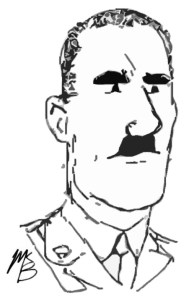
I spoke to Sutcliffe. He seemed tired, discouraged and distressed saying his men were exhausted, as indeed they and everyone else were … I told him he could have six hours rest and that his Battalion must be ready after that to take its place again in the line. It did so and put up a grand show in the final days.
(Brig. A Peffers quoted in Lindsay Oliver, The Battle for Hong Kong, 121)
Born on 29 August 1898 in Yorkshire, England, John Louis Robert Sutcliffe was a Manitoba civil servant and First World War veteran. He had enlisted with the 6th Battalion in September 1914 and went to France as a trooper with the Royal Canadian Dragoons in June 1915. He took an Imperial Army commission with Worcestershire Regiment in November 1916 and ended the war fighting in the Caucasus and the Near East. He rejoined the Canadian militia on his return home and was second-in-command of the 1st Battalion, Winnipeg Grenadiers on mobilization in September 1939.
While the 2nd (Reserve) Battalion remained at the depot in Winnipeg, the 1st Battalion went to Jamacia for garrison duty in June 1940 as part of Y Force. There Sutcliffe was promoted to lieutenant-colonel in May 1941 succeeding Lieutenant-Colonel O.M.M. Kay. After over a year in the West Indies, the battalion returned to Canada in September. The 2nd Battalion hosted a homecoming, prompting Sutcliffe to observe the “historic occasion” of the two Grenadier battalions celebrating together. Two months later, although not well prepared to active combat, the 1st Battalion under Sutcliffe’s command was sent to reinforce the British garrison at Hong Kong.
The Grenadiers joined the Royal Rifles of Canada under Lieutenant-Colonel W.J. Home as part of C Force under the overall command of Brigadier John K. Lawson. The Canadian reinforcements arrived in Hong Kong less than a month before the Japanese siege began on 8 December. The Grenadiers were the first Canadian infantry battalion to engage the enemy in the now three-year-old war.
After Lawson and his second-in-command Pat Hennessey were missing and presumed killed on 21 December, Home took charge of the shattered brigade. After receiving a message from Ottawa commending them for their “brave resistance of the forces that are seeking to destroy the world’s freedom,” Sutcliffe replied bluntly, “Situation critical. Canadian troops part prisoner, residue engaged casualties heavy … But troops have done magnificent work, spirit excellent.”
Despite doubts that orders from higher command wasted his soldiers’ lives, Sutcliffe and the battalion fought until the end before surrendering to the overwhelming Japanese forces on Christmas Day. While confined as a prisoner of war North Point Camp, Hong Kong, his health quickly deteriorated. Sutcliffe died on 6 April 1942, likely from a combination of beriberi, malaria, dysentery, and anemia. One imprisoned Grenadier speculated, “I think myself he died of a broken heart.”
Second-in-command Major George Trist took charge of the imprisoned battalion. Although in a regimental sense the unit had been destroyed in the Battle of Hong Kong, by the time of Sutcliffe’s death, a reconstituted 1st Battalion, Winnipeg Grenadiers had formed back in Canada.
 World War Graphic History