Lieutenant-Colonel W.J. Home
Royal Rifles of Canada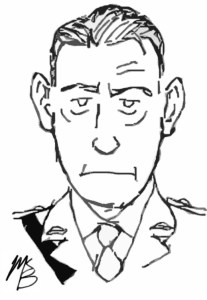
[Home] and his men were bearing the brunt of the fighting and knew from first hand knowledge the strength and armament of the forces against them. The Higher Command had consistently shown an inability to grasp the realities of the situation and to pursue tactics which might have prolonged the struggle but could not have altered the final result.
(Brig. J.H. Price to G.W.L. Nicholson, 27 Jan 1948)
Born on 6 April 1897 in Quebec City, William James Home was a Permanent Force officer of the Royal Canadian Regiment and decorated First World War veteran. He mobilized with the 8th Royal Rifles in August 1915, took a commission with the RCR in February 1915 and was promoted to captain overseas. He earned the Military Cross for gallantry during the Battle of the Scarpe in August 1918: “When almost, surrounded by an enemy counter-attack he dashed forward at the head of a party, shooting four enemy himself, causing considerable casualties and checking, their attack. His courage and initiative saved an awkward situation.”
Home made a postwar career in the Permanent Force with the RCR rising to the rank of major. When the regiment mobilized for active service, Home served as a company commander but was left behind when the RCR embarked for overseas in December 1939. Although superiors expressed doubts about his fitness for higher promotion, he was appointed commanding officer of the newly mobilized Royal Rifles of Canada in July 1940.
Following garrison duty in Newfoundland, the Rifles was selected to reinforce the British defence at Hong Kong. The Rifles joined the Winnipeg Grenadiers under Lieutenant-Colonel J.L.R. Sutcliffe as part of C Force under the overall command of Brigadier John K. Lawson. The Canadian reinforcements arrived in Hong Kong less than a month before the Japanese siege began on 8 December. After Lawson and his second-in-command Pat Hennessey were missing and presumed killed, Home took charge of the shattered brigade in the final days of the battle.
Brigadier Cedric Wallis, who appeared to have become mentally unbalanced during the fighting, claimed that Home had “urged that his men were unfit to continue the struggle which had become a useless waste of lives.” Viewing such an attitude as defeatist insubordination, Wallis contemplated either arresting or shooting Home. Despite Home’s recognition of the hopeless situation, Wallis would continue to order counterattacks leading to more Canadian casualties.
After days of desperate fighting, the Hong Kong garrison fell, and the survivors finally surrendered on Christmas Day. Both Canadian battalions were destroyed with all soldiers either killed or captured. Home spent the next three-and-a-half years as a prisoner of war until liberation in August 1945. He was retroactively promoted to brigadier and retired from the army in 1948.
His performance at Hong Kong became a point of controversy in the much-contested history of the battle. According to Wallis and the colony’s senior military officer, General Christopher Maltby, Home had urged the withdrawal of Canadian forces and attempted to circumvent the chain of command by appealing directly to the colony’s governor. The harshest criticism of the discipline and even the courage of the Canadian battalions would be censored in Maltby’s final 1948 report. “From the point of view of historical accuracy, we are naturally anxious to arrive at the true facts of the case,” deputy director of the army historical section, G.W.L. Nicholson wrote in January 1948, “Brigadier Home has not been approached on the matter, which it was felt, might be a source of embarrassment to him.”
Rather than approach Home, Nicholson asked for the perspective of Major John H. Price, second-in-command of the Royal Rifles. “In my opinion Brig. Wallis’ report is not to be relied upon,” Price replied. “He was then in such a state of great nervous excitement and I believe his mental state was such that he was incapable of collected judgement or of efficient leadership. The insinuation in his report is that Brig. Home suggested a complete and final withdrawal of the Canadian force from the fighting. This is untrue and I so told General Maltby.”
Price described the circumstances that Home faced after the death of Brigadier Lawson on 21 December:
As such he inherited responsibilities which he took very seriously and which caused him great anxiety. It required no great military genius to predict the outcome of the battle once the Japanese had landed on the island with their control of sea and air and great superiority in weapons and men. He felt, I think rightly, that he would be derelict in his duty to his men and to the Canadian Government if he did not communicate his conclusions to the highest authority.
Home died on 2 August 1983, and is buried in Hudson, Quebec.
 World War Graphic History