Lieutenant-Colonel Bill Halpenny
22nd Armoured Regiment (Canadian Grenadier Guards)
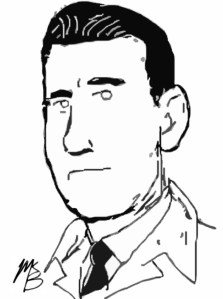
We as manufacturers should not look at them (trade unionists) as the gestapo. We should become leaders. The labor man needs a little leadership. He needs a square deal … We’re better to have our laws and contracts lenient toward them. It’s when you stary to curb them we’ll find the type of though that isn’t Canadian.
(Windsor Star, 29 May 1947, 6)
Born in Winnipeg on 14 November 1909, William Walton Halpenny first joined the Fort Garry Horse as a cadet officer in 1927. With the outbreak of the Second World War, he was selected for a tank training course in England. He rejoined the Fort Garries, soon to be converted to the 10th Armoured Regiment, and went back overseas in 1942. In November, he was promoted to lieutenant-colonel of the Canadian Armoured Corps reinforcement unit and by September 1943 had been appointed new commanding officer of the 22nd Armoured Regiment (Canadian Grenadier Guards).
Halpenny replaced Lieutenant-Colonel M.F. Peiler, who had commanded the unit since mobilization over three years earlier. After almost a year preparing the unit for combat, Halpenny led the Grenadier Guards to Normandy in July 1944. During Operation Totalize in early August, he commanded “Halpenny Force” including his own unit and a mix of mechanized infantry, an anti-tank battery, and engineers.
During Operation Tractable, he temporarily found himself commanding 4th Armoured Brigade when Brigadier Leslie Booth was killed on 14 August and his replacement Lieutenant-Colonel M.J. Scott of the Governor General’s Foot Guards was evacuated wounded soon thereafter.
On 19 August, Brigadier R.W. Moncel took over the brigade and Halpenny returned to the Grenadier Guards. Although one subordinate noted he rarely led from the front, he earned the Distinguished Service Order, a mention in despatches, and Croix de Guerre. The latter citation read in part:
Lieutenant-Colonel Halpenny commanded a Canadian Armoured Regiment during all the action in which they have taken part in France. During August he was called upon to launch an attack which was to relieve the Polish Armored Brigade, cut off as a result of strong enemy counter-attacks originating in the Falaise pocket. Col. Halpenny’s coolness under fire and skilful direction of the forces at his disposal was responsible for sustaining the momentum of the attack.
On 18 December 1944, he was succeeded by Major H.A. Smith, who had earned the Military Cross fighting with the 11th Armoured Regiment in Italy. Of his predecessor, Smith later remarked, “with all due respect for Halpenny, he was not the man for the job … I served under a number of COs in my career in the army and he certainly was one of the weaker ones.”
A week later Halpenny attended a Christmas dinner along with fellow former commanding officers Peiler and Griffith. According to the war diary, Halpenny “expressed his pleasure at being over again—he had left so shorty before to enter the painful atmosphere of Army HQ,” an allusion to his relief from command.
After the war, Halpenny worked in the manufacturing business in Brantford, Ontario. He died in Toronto on 23 February 1955.
 World War Graphic History