Lieutenant-Colonel E.M. Smith
21st Armoured Regiment (The Governor General’s Foot Guards)
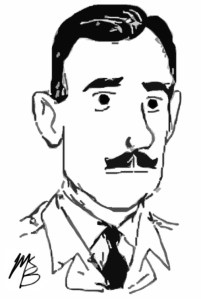
His unique personality and quick understanding of the problems of those under his command made him an outstanding figure in the life of the Regiment from the very beginning … the Governor General’s Foot Guards would enter the battles ahead with a commanding officer of great tactical ability and one who would always look after “his boys” and ensure that the Regiment would continue to add laurels to its already famous name.
(The Guard’s Star, 22 Sep 1945, 2)
Born in Ontario in 1904, Edward Marshall Smith served as a captain in the Regiment de Hull but transferred to the Governor General’s Foot Guards following mobilization in 1940. The regiment converted to armour in 1942 and he preceded the re-designated 21st Armoured Regiment to England for special training. When the Foot Guards deployed to France in July 1944, Smith commanded a tank squadron.
On 16 August 1944, Lieutenant-Colonel M.J. Scott was medically evacuated with a broken ankle. When acting second-in-command Major H.F. Baker was wounded by a sniper a day later, Smith took over. He led the Foot Guards for the remainder of the North West Europe campaign, earning the Distinguished Service Order for his actions on 28 October 1944:
Throughout this op Lt-Col Smith displayed the greatest imitative and fortitude. Constantly under [heavy] aimed fire, he personally directed the op of his regt and it was only by his skill, perseverance and example that a route to this dominating position was discovered. The success of the regt is a gauge of his efforts. His courage and devotion to duty under extremely difficult conditions are in keeping with the best of Cdn fighting traditions.
Smith returned to Canada in September 1945, turning command over to Major G.T. Baylay. The regimental newspaper, The Guard’s Star, printed a sketch drawn by a Guardsman and a tribute:
Remaining with the Regiment until those with much lower point scores had been returned to Canada, his repatriation is well deserved after perhaps the most distinguished career of any officer in the regiment. The sense of personal loss felt by all members of the regiment who know him, clearly indicates the magnitude of the loss felt by the regiment as a whole. We say “Au Revoir” to a grand fellow and a real friend and the Regiment now wishes him every success and happiness back on “Civvy street.”
“[T]hanks for the grand write up,” Smith wrote to his successor. “I am sure I don’t deserve that but it’s nice to see it in print.”
Having retired from the army in 1954 at the rank of brigadier, Smith served as assistant sergeant-at-arms of the House of Commons for several years until his death in Ottawa on 12 February 1970.
 World War Graphic History