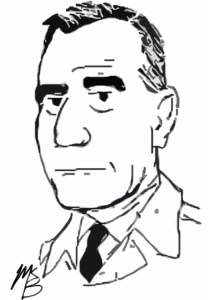
Lieutenant-Colonel M.J. Scott
21st Armoured Regiment (The Governor General’s Foot Guards)
I do want to say that my days with the Regiment were very happy and I am very grateful for the co-operation, the loyalty and the deep sense of duty shown at all times by all ranks. It is my desire to render any service at any time, within my power, to the Regiment and to those who have served with it.
(Scott letter, war diary, 12 Oct 1944)
Born on 20 Nov 1902 in Saint John, New Brunswick, Murray Joseph Scott began his militia service with the Saint John Fusiliers and then joined the Canadian Grenadier Guards on moving to Montreal in 1933. He mobilized with that battalion as a major and company commander but in 1942 transferred to the Governor General’s Foot Guards as second-in-command under fellow Grenadier Lieutenant-Colonel H.W. Rick.
He succeeded Rick in August 1943 and led the Foot Guards as part of the 4th Armoured Brigade to Normandy in July 1944. When Brigadier Leslie Booth was killed on 14 August at the outset of Operation Tractable, Major-General George Kitching appointed Scott to take over 4th Brigade. Unknown to Kitching, Scott had suffered a broken ankle when his tank had been hit earlier that day. He was medically evacuated twenty-four hours later.
“[I]f I had known that Murray Scott had been injured before I appointed him to replace Booth,” Kitching later wrote, “I would not have bothered with him at all. I would have taken over the Armoured Brigade myself rather than have it go through three commanders in thirty-six hours.” For the failure to more quickly close the Falaise Gap, Kitching would be fired soon thereafter.
Lieutenant-Colonel W.W. Halpenny of the Canadian Grenadiers took over the brigade while command of the Foot Guards passed briefly to Major H.F. Baker before Major E.M. Smith took over on 18 August. Unfit for a return to combat duty, Scott returned to Canada at the end of 1944. He wrote to the Foot Guards:
My greatest regret is that this move will sever my active connection with the Regiment. It has been with much pride that I have worked with you and a great honour to have commended the Regiment during the last year of training in England and its early operations in France.
To you, who have served so faithfully and well, who have never failed in any task and who were equally capable be it in a ceremonial guard or a tough operational assignment, I say that there is nothing that you cannot accomplish and I know that the prestige of the Regiment will be further glorified in your actions to come and all who have served with you will look back on these days with pride.
After the war, he resumed his civilian work in the lithography business but remained active in the reserve army. From 1949 to 1950, he served as commanding officer of the Canadian Grenadier Guards.
Scott died on 23 July 1984 in Montreal.
 World War Graphic History