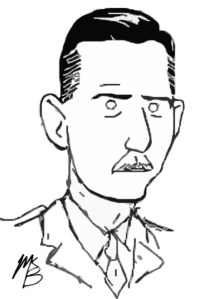
Lieutenant-Colonel W.G. Wurtele
21st Armoured Regiment (The Governor General’s Foot Guards)
First of all he must make himself a psychologist with one end in view—The mutual trust and reliance between himself and his men, that he is worse than useless unless he develops. You need have no fear about your men, they will do their part if you do yours. You have the real job and you need have no illusions that you can fool your men.
(Wurtele address, war diary, 6 Feb 1940)
Born on 27 October 1895 in Kingston, Ontario, William Godfrey Wurtele was a decorated First World War veteran and commanding officer of the Governor General’s Foot Guards since 1938. As a student at RMC, where his father was a professor, he enlisted in the 59th Battalion in February 1916. He served as a lieutenant with the Royal Canadian Regiment in France, where he was three-times wounded and twice gassed. By the end of the war, he had earned the Military Cross for “dashing leadership” in capturing an enemy battery.
Denied a post in the postwar Permanent Force, Wurtele joined the Governor General’s Foot Guards in Ottawa, where he worked as an accountant for the department of national defence., He assumed command of the Foot Guards in March 1938. “We cannot continue to dwell on the past when we have such important grim business ahead of us,” he announced to his officers just prior to mobilization in 1940. “The old idea of standing around and looking bored, important and decorative is absolutely dead if it really ever existed.” He elaborated on the duties and responsibilities of commanding officers:
Your men have a right to expect you to know all the finer points of the game … If they know you have this they will be confident that you will not get them lost and, therefore, probably not lead them to disaster or useless death. The same could be said of tactics or even military law.
However, above all, you must as soon as possible, let them see that you do not consider them as inferior, lesser beings over whom you intend to lord it, that is, expect everything and give nothing yourself. They all fear having such an officer over them and are peculiarly quick to take offence at or resent such an animal. You must be their champion, ready to go to the mat for them at all times …
To do the latter you can never learn too much about them, their background, their civilian lives, their hobbies, their likes and dislikes, their capabilities and shortcomings. Talk to them, and above all, never miss recognizing them. To do all this and still remain in fact their leader, takes constant and careful finesse
The Guards mobilized in May 1940 and convert to the 21st Canadian Armoured Regiment in February 1942. A month earlier, Wurtele had relinquished command due to medical unfitness for active service. He was succeeded by Lieutenant-Colonel H.W. Rick, formerly of the Canadian Grenadier Guards.
Wurtele served as aide-de-camp to two Governor Generals of Canada, Lord Tweedsmuir and Earl Athlone. He worked for Veteran Affairs until retirement in 1962. He was joint chairman with the last commanding officer, Lieutenant-Colonel G.T. Baylay, of the committee that prepared the regimental history of the Governor General’s Foot Guards.
Wurtele died on 26 July 1979 in Victoria, British Columbia.
 World War Graphic History