Brigadier H.W. Murdock
North Nova Scotia Highlanders
18th Infantry Brigade
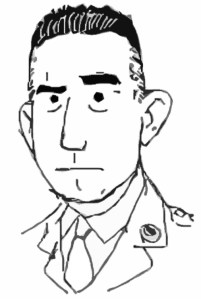
Lance-Corporal Horatio W. Murdock was in charge of a Lewis gun which he used with great skill and deadly execution. When his platoon was putting outposts on a railway embankment strongly held by the enemy, he advanced with his Lewis gun at close range, giving covering fire and holding the enemy back, inflicting heavy casualties on him. By his courage and skill he enabled the post to be established with small
(The 85th in France, 170)
Born on 4 April 1895 in Amherst, Nova Scotia, Horatio Ward Murdock was former head of the Canadian Infantry Association and commanding officer of the Cumberland Highlanders from 1930 to 1936. He had enlisted with the 193rd Battalion in March 1916 and two years later reverted from sergeant to corporal to join the 85th Battalion in France. He earned the Good Conduct Badge and was training to be an officer when the war ended.
In the postwar military, Murdock took a commission with the Highlanders and rose to command ten years later. He was succeeded by Lieutenant-Colonel A.G. McLellan in March 1936 and after the redesignation to the North Nova Scotia Highlanders, Murdock retired to the reserve officer list.
With the outbreak of the Second World War, he was appointed commandant of the infantry training centre in Halifax. When the NNSH mobilized in June 1940, Murdock succeeded McLellan, who transferred to the 2nd (Reserve) Battalion. The NNSH went overseas in July 1941 and Murdock remained in command for almost another year. The battalion leadership had a poor reputation among some elements of 3rd Division. One soldier wrote home:
There’s a bunch of the boys going back to the Unit are they ever sore nobody wants to go back I was scared that they might send me that’s the last place I want to go is to the N.N.S.H. unless they get rid of the bunch of dough heads that’s running it I honestly believe that when they go into action that they will be wiped out and they are the best bunch of boys over here in any unit.
During General Bernard Montgomery’s inspection tour of the 9th Infantry Brigade in February 1942, he found Murdock slow and overcautious but otherwise a competent CO. Although Monty doubted his fitness for command of a brigade, Murdock was recalled to Canada in June for a promotion to brigadier in the 7th Division. He handed command over to Major K.R. Mitchell and assumed command of the 18th Infantry Brigade with Pacific Command until October 1943.
In 1944, Murdock was assigned to one of the officer survey and classification boards as chairman, He retired from the army in October 1945. In recognition for his long service, he was made Commander of the Order of the British Empire.
Murdock died in Truro, Nova Scotia on 8 March 1963.
 World War Graphic History