Lieutenant-Colonel Neil Gemmell
Stormont, Dundas and Glengarry Highlanders
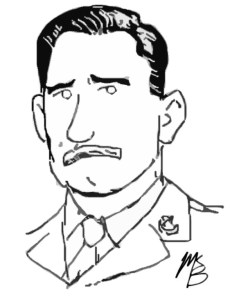
Major Gemmell personally led his men and. fought shoulder to shoulder with them from one slit trench to another … Undoubtedly it was due to Major Gemmell’s remarkable qualities of leadership, inspiring actions and personal courage that his much depleted force attained its objective.
(Croix de Guerre citation quoted in War diary, 23 Apr 1945)
Born on 27 April 1910 in Peterborough, Ontario, Neil Morrison Gemmell was a junior officer with the Stormont, Dundas and Glengarry Highlanders when it mobilized in June 1940. He was promoted to major in September 1943 and served as “B” Company commander on D-Day and in Normandy. He became second-in-command after Caen in July and succeeded Lieutenant-Colonel Roger Rowley in March 1945.
Shortly after taking command, the battalion learned Gemmell had earned the Croix de Guerre for his actions on 8 July 1944 at Gruchy. After all “B” Company officers had been wounded or killed, Gemmell “was to be seen everywhere personally supervising the consolidation of Company’s position and encouraging his men.” He went on to earn the Distinguished Service Order for “great coolness, determination, courage and good judgement” during operations on the Rhine and Holland from February to April 1945:
Lieutenant-Colonel Gemmell led his battalion against fanatic young German paratroopers of a paratroop training regiment. In spire of suicidal resistance the battalion captured its objective, the high ground to the south-west of Zutphen. The Commanding Officer was to be seen everywhere, encouraging his men and planning the next attack … The dashing leadership of Lieutenant-Colonel Gemmell in all these operations has been one of the principle factors in the success of the Stormont, Dundas and Glengarry Highlanders.
Gemmell commanded the battalion through VE-Day before becoming acting brigadier of 9th Infantry Brigade. During this absence Major J.W. Braden took over the SDGH. When the battalion returned to Ottawa for demobilization, Gemmell addressed the battalion for the last time: “I come to it with mixed feelings. To each one of you I wish the best of luck in the future. You are fine soldiers. Now be good citizens. Carry with you into life and profit from the lessons you learned in warfare. Display in civvies, the same loyalty and devotion to duty as you did in battledress and under fire.”
Gemmell remained in the postwar army, serving as commanding officer of the 1st Battalion, PPCLI from 1947 to 1950 and then assistant adjutant and quartermaster-general in Manitoba. In 1953, during the Korean War, he was posted to Far East army headquarters at Kure, Japan in command the 25th Reinforcement Group.
He retired from the army in 1961 and died in Peterborough on 7 October 1979.
 World War Graphic History