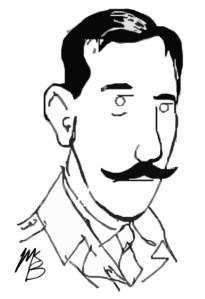
Lieutenant-Colonel Roger Rowley
Stormont, Dundas and Glengarry Highlanders
They kept coming in and God—if they lasted twenty-four hours, they were lucky. They just came in, went out on the line, and zap—they were either wounded or killed. They were nice guys, but they weren’t much use to me wounded or dead.
(Quoted in Denis Whitaker, Tug of War, 224)
Born on 12 June 1914 in Ottawa, Ontario, Roger Rowley graduated from Dalhousie University and worked as a bond trader in the nation’s capital. Commissioned with the Cameron Highlanders of Ottawa since 1933, he served with the unit on garrison duty in Iceland in 1940 before proceeding to England in 1941. Following a series of promotions, Rowley became lieutenant-colonel of a training wing but reverted back to major to be second-in-command of the Cameron Highlanders when the machine gun battalion deployed to Normandy.
On 4 August 1944, Rowley replaced Lieutenant-Colonel G.H. Christiansen of Stormont, Dundas and Glengarry Highlanders. Christiansen had lost his command after disagreements with senior generals and indicating his refusal to carryout what he viewed as a wasteful attack. Arriving as a new unit as a stranger, Rowley later reflected:
They loved their CO, Christiansen, and they were mad because he was fired. So they didn’t like me. The only two people I knew when I arrived at battalion headquarters were my driver and my batman, and I brought them both with me. I had a pretty rough time there for a while, but we got along well at the end.
(Denis Whitaker, Victory at Falaise, 185)
Rowley quickly proved himself a worthy successor to the troop’s popular former CO. He earned a Distinguished Service Order for “dash, leadership, bravery and unlimited energy” in the September 1944 capture of Boulogne. He received a D.S.O. Bar for “such brilliance, courage, and speed” in the Battle of the Scheldt in October:
In spite of the shortage of time Lieutenant Colonel Roger Rowley planned and ordered the new attack with such brilliance and led it with such determination that the Garrison was quickly overcome and Breskens captured. The capture of this port cut off the last remaining line of retreat, support, or reinforcement.
“It was dammed difficult reading maps when most of the landmarks were under water,” Rowley said of the fighting conditions in Holland. “They men were spoiling for a bruise, and they went in with bayonets, knives and gun butts, I don’t know who they lived through it. The Boche never knew what happened.” Despite pride in his battalion’s accomplishments, the colonel had grown frustrated with the reinforcement situation. “We had five divisions,” he later complained, “of trained men sitting back thee in Canada, and that SOB Mackenzie King just wouldn’t send them overseas.”
His older brother, Lieutenant-Colonel John Rowley, commanded the North Shore Regiment. Known as the “brothers act,” the pair collectively earned three D.S.O.s, however John’s would be awarded posthumously. He was killed in action on 26 March 1945 shortly after Roger had been relieved and replaced. In early March he was posted to command a training school in England and succeeded by Major Neil Gemmell. Rowley returned to Canada shortly thereafter for training duties for the Pacific theatre prior to Japan’s surrender.
Postwar, Rowley pursed a professional military career with the Canadian Army and NATO. He retired in 1968 at the rank of major-general and served as honorary colonel of the Cameron Highlanders of Ottawa.
He died in Ottawa on 14 February 2007.
 World War Graphic History