Lieutenant-Colonel M.S. Dunn
Stormont, Dundas and Glengarry Highlanders
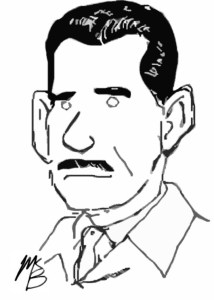
A soldier is just as much a citizen as any other person. He must be a good citizen first. He can’t be a good soldier otherwise. I feel that every person in the Canadian Army has a definite responsibility toward the community where he is stationed. He must not be merely an onlooker.
(Kingston Whig-Standard, 4 Aug 1955)
Born in 1905 in Old Chelsea, Quebec, Michael Stephen Dunn graduated from the University of Ottawa and was a school teacher and vice principal in Cornwall, Ontario. Originally second-in-command of the Stormont, Dundas and Glengarry Highlanders, Dunn reverted to captain to go overseas with the 1st Division headquarters staff in December 1939. Following appointments with Canadian Military Headquarters in London, he was promoted to lieutenant-colonel and deputy assistant adjutant-general.
Dunn returned to his old militia unit when he succeeded Lieutenant-Colonel W.S. Rutherford as commanding officer of the SDG Highlanders in September 1942. Following his brief tenure, in December, Dunn returned to administrative duties. He served as head of Canadian Section with General Headquarters, 2nd Echelon in North Africa and the Italian theatre, earning the Order of the British Empire and a mention in despatches. In May 1945, he returned to Ottawa to be deputy assistant adjutant-general and then head of Canadian section in the anticipated Allied Pacific Force.
He remained in the army after the war as director of organization and commandant of Camp Borden, and was promoted to brigadier in 1949. He was first commanding officer of Newfoundland Area when the province entered Confederation. In the early 1950s, he commanded Eastern Ontario Area and served as special court martial president for several trials in Korea. In 1955, he acted as military adviser to the Canadian Commissioner in Vietnam. By the time he retired from the army in 1960, he worked in the office of the chief of general staff.
Of the next generation, the former teacher and principal Dunn once observed: “There is nothing wrong with youth of today. When delinquency does occur, it usually is the fault of grownups for not providing recreational facilities. To assure that they grow up to be good citizens our youth must have a proper, comprehensive and supervised leisure time program.” After his army career, Dunn became principle of George Brown College until retirement in 1970.
Dunn died in Ottawa on 13 May 1989.
 World War Graphic History