Lieutenant-Colonel Nichol Kingsmill
Highland Light Infantry of Canada
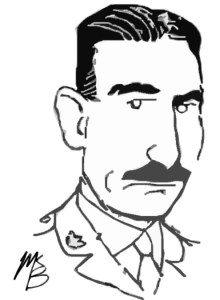
Does not feel able to think and has no confidence that he can carry on. This officer in my opinion has an anxiety state which is associated with the handling of men. His chief fear seems to be the responsibility of sending men and officers out on missions from which he knows they are likely not to return. He is afraid of unnecessary casualties through some error on his part.
(Neuropsychiatrist report, 6 Nov 1944)
Born on 22 December 1906 in London, Ontario, Nicol Kingsmill was a Toronto lawyer and graduate of the University of Toronto and RMC. He was son of Lieutenant-Colonel Walter Bernard Kingsmill (1976—1950), commanding officer of the 123rd Battalion in the First World War. The younger Kingsmill served with the Canadian Officer Training Corps and the Royal Regiment of Canada before returning to Canada in January 1942 with an appointment to be a brigade major in the 6th Division.
He served with the Pacific Force at Camp Nanaimo but returned to the United Kingdom in 1943. He was then attached to British Army in the North African theatre to gain combat experience and served as a company commander in the Royal Inniskilling Fusiliers in Tunisia. Brigadier Nelson Russell of the 38th (Irish) Brigade, reported satisfactorily to the Canadians:
It was a great pleasure to us to have him and he came at the time when we most needed good officers and N.C.Os, namely when had out first officer and N.C.O. casualties. He worked throughout with great zeal and I hope that he has been able to put over to you all the many useful lessons which he must have learnt. It is a pity that he was not able to stay until the successful end of the campaign and see the Irish Brigade lead the way into Tunis.
As a postscript, Russell added, “Don’t think Kingsmill is too old—he is younger than most chaps half his age.” On return from North Africa, Kingsmill was appointed brigade major in the 9th Infantry Brigade. Just over a year later the brigade deployed in the Normandy invasion of 6 June 1944.
When Lieutenant-Colonel F.M. Griffiths of the Highland Light Infantry was wounded at Caen on 8 July 1944, Kingsmill went forward to take command of the battalion on 20 July. He led the HLI through the fierce fighting in Falaise but was put out of action when his Bren Gun carrier hit a mine in October 1944. Although physically unwounded, the near miss triggered a nervous breakdown exacerbated by prolonged fatigue and worry. Just as Kingsmill had done three months earlier, brigade major Phil Strickland of the 9th Infantry Brigade arrived as his replacement.
Kingsmill was hospitalized at No. 1 Neurological Hospital at Basingstoke, where he was diagnosed with mild psychoneurosis anxiety. The head of the neuropsychiatric unit, Lieutenant-Colonel C.E. Gould reported:
Looks tired and drawn, eyes slightly injected. Tense and a little jumpy, and lacks self-confidence … By his history this officer is a high strung type, with a history of neurotic trends on the paternal side of the family, but his civilian and army adaptation has been excellent, and the factor of physical exhaustion is a large one, obviously, in this case.
After several weeks in hospital, he recovered his self-confidence and would return to Canada in early 1945. With his father in failing health, he applied for early retirement from the army to take over the family law firm.
He died in Toronto on 10 February 1976.
 World War Graphic History