Lieutenant-Colonel Frank Griffiths
Highland Light Infantry of Canada
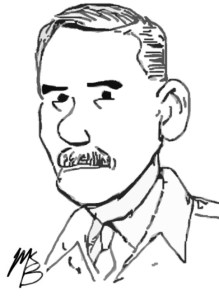
Although all good biographies start with date and place of birth, Nifty would be the most disappointed man in the would if one failed to refer to Niagara Falls. Griff, though small of stature has an enviable record as an athlete … His infectious good humour and endless supply of good jokes has helped us over many a blue day.
(RMC Review, Class of 1931, 30)
Born in Niagara Falls, Ontario, on 2 October 1909, Franklyn McCallum Griffiths was a graduate of the Royal Military College and an Osgoode Hall-trained lawyer in Niagara. He had belonged to the Lincoln and Weiland Regiment before the Second World War and transferred to the Royal Canadian Regiment in late 1939. He completed a course at RMC in 1942 and served as brigade major and staff officer when he went back to England.
He succeeded Lieutenant-Colonel R.F. Shantz of the Highland Light Infantry in January 1944. Six months later he commanded the battalion when it went ashore at Juno Beach on 6 June 1944. A month later he led the assault at “Bloody Buron” for which he earned the Distinguished Service Order:
During the early stages of the attack on BURON on 8 Jul the Colonel directed the advance by wireless … All this time he was under very heavy mortar, shell and small arms fire and constant target for snipers as he directed the coys forward. Realizing the coys were meeting with bitter opposition and being held up he entered the village from the West flank and moved to a position ahead of the unit there he could command a better view of the battle, by so doing he was actually in an isolated position but managed to speed up the advance and bring the action to a successful conclusion at grave danger to himself.
He left his command post and went out and saw that the coys were firmly consolidating their position. By his coolness under fire and steady direction of the battle he brought about the successful capture of this strongly held position. During the later stages of the battle he was wounded and continued to command until he was evacuated.
An enemy shell struck the battalion command group, killing four and wounding two senior officers. Griffiths was put out of action by bomb fragments to his chest and leg. He was succeeded by Major Nichol Kingsmill, brigade major for the 9th Infantry Brigade. When asked how he felt about the recent awarding of his D.S.O., “A bit embarrassed,” Griffiths replied, “And I still don’t know anything about the citation.” In the same interview, he described how he found himself laying on a stretcher next a wounded German officer both awaiting evacuation:
It was the most unusual experience. I couldn’t speak German and he couldn’t speak English, but through the interrogator I learned he was the battalion commander who had opposed us. He was too sick to talk and I haven’t found out if he lived. I’m sorry I couldn’t talk to him; there are a few things I’d like to have asked him.
Griffiths proudly described how not one of his men had been captured in the month he had commanded in the field. The Germans, by contrast, feigned surrender with a white flag only to shift positions and advance closer. “I saw that happen twice,” he stated, “the third time they tried it … they just tried it.” He returned home and on recovery was posted to No. 7 military district headquarters (St. John, New Brunswick) as a staff officer.
After the war, Griffiths resumed his law career as a Queen’s Counsel in the 1950s and later served as a judge in Welland and Niagara. He died on 5 July 1991 in Southampton, Ontario.
 World War Graphic History