Lieutenant-Colonel John Rowley
North Shore Regiment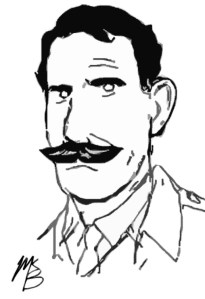
As lieutenant-colonel, commanding the North Shore (New Brunswick) Regiment, I selected Major John Rowley, Cameron Highlanders of Ottawa, who won my heart on his first and only interview with me when he said, ‘Sir, I can have no greater honour bestowed upon me than to command a Canadian regiment in battle.’ He was a romantic, not bombastic, and what he did with his first command is unbelievable.
(Gen. J.A. Roberts, The Canadian Summer, 104)
Born on 2 December 1912 in Ottawa, John William Horsley Rowley had a law degree from Dalhousie University and was a barrister-at-law in the nation’s capital. He took a commission with the Cameron Highlanders of Ottawa in 1932 and was promoted captain in September 1939. Following garrison duty in Iceland in 1940-41, he served as instructor at the company commander school in England then took up staff duties with 3rd Division, 8th Infantry Brigade, and First Canadian Army in 1942.
By his education and personality, he struck many superiors as ideal for the role of a general staff officer. Brigadier K.G. Blackader of 8th Brigade observed that “Major Rowley has a very pleasant personality … throughout he has shown ability and initiative. He was a lawyer in civil life and in my opinion has definite qualifications for meeting other people and transmitting orders. Throughout the time of his appointment at this H.Q. he has carried out his duties in a very loyal and efficient manner and in my opinion he Is suitable for staff work and I recommend that he should be given additional staff training.”
Recommended for staff officer training at Camberley, another brigadier noted that Rowley possessed “a pleasant personality, soldierly appearance, and has shown initiative and common sense. He has a sound military background, and is interested and ambitious.” After completing the course, he resumed staff officer duties with 3rd Division.
Rowley rejoined the Cameron Highlanders of Ottawa for the invasion of Normandy and served as second-in-command of the machine gun battalion. He was most noted for securing the surrender of a German garrison in a Dutch town after convincing them that they were hopelessly surrounded. When Lieutenant-Colonel J.E. Anderson was relieved in December 1944, Rowley arrived as his replacement. His younger brother, Lieutenant-Colonel Roger Rowley, commanded Stormont, Dundas and Glengarry Highlanders. Known as the “brothers act,” the pair collectively earned three D.S.O.s, however John’s would be awarded posthumously.
The citation for an attack on 26 February 1945, read in part:
Lieutenant-colonel John William Horsley Rowley, commanding the North Shore Regiment, re-organized the attack. Under extremely heavy enemy shell and machine-gun fire, he personally led the first wave of the attack over 1800 yards of flat open country, calmly moving directly across country toward the objective. Lieutenant-colonel Rowley’s gallant action, the apparent lack of fear, and calm determination, inspired his men and was instrumental in the complete success of the battalion and the brigade plan.
Rowley was killed in action by German artillery fire exactly one month later and is buried in Groesbeek Canadian War Cemetery in the Netherlands. His widow would receive his posthumous Distinguished Service Order. Brigadier J.A. Roberts, who had promoted Rowley to command the North Shore Regiment, later remarked, “I felt that he would have been happy to die in such a way.”
 World War Graphic History