Lieutenant-Colonel Ernie Anderson
North Shore Regiment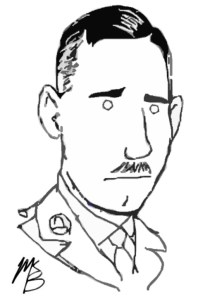
I am sure that at some time during the attack every man felt he could not go on. Men were being killed or wounded on all sides and the advance seemed pointless as well as hopeless. I never realised until the attack on Carpiquet how far discipline, pride of unit, and above all, pride in oneself and family, can carry a man even when each step forward meant possible death.
(Quoted in Will Bird, North Shore (New Brunswick) Regiment, 269)
Born on 24 August 1911 in Burnt Church, New Brunswick, James Ernest Anderson had a law degree from the University of New Brunswick. He joined the North Shore Regiment as a lieutenant in 1940 and served as “D” Company commander on D-Day, witnessing some of the some brutal fighting in Normandy. Nicknamed “Uncle Ern,” he rose to be second-in-command and succeeded Lieutenant-Colonel D.B. Buell when he was wounded on 10 August 1944.
He earned the Distinguished Service Order for leading the battalion under heavy fire in an attack near Boulogne in September 1944: “Throughout the whole operation [Anderson] more than proved his ability as a Commander, and by his cool courage, initiative, sound planning and leadership, he not only was an outstanding example to his battalion, but his personal efforts contributed in no small way to the success of the whole operation.”
After five months of near continuous action in France and Belgium, the battalion war diary reported at the end of October, “Casualties were not high but battle exhaustion cases were numerous. Morale is of a fair standard, but troops are in need of a rest.” By December 1944, Anderson was relieved of command for extended rest in England. In a confidential report, Major-General Dan Spry of 3rd Division concluded, “I consider this offr to be tired. He has done an efficient job and served his battalion well. He has lost his drive and I consider a change of emp necessary in the interest of the continued zeal of his bn.”
Battalion adjutant Major Hal Macdonald explained the strain for the senior officers during this period, writing, “Would get so tired I’d go to bed and just shake & shiver & feel as if I wanted to break down and weep.” Mentally exhausted, Macdonald decided he needed a change of environment as well and transferred to brigade headquarters. “Felt I had more than done my share – been adjutant and doing a large part of 2 i.c’s job for over two months & getting short-tempered & irritable & nervous. Nuts to that,” he wrote. “A big change & a chance to catch up on sleep & mental outlook. Hated to see Uncle Ernie leave but it may be o.k.” Lieutenant-Colonel J.W.H. Rowley, former 2ic of the Cameron Highlanders of Ottawa took over the North Shore.
Anderson returned to New Brunswick and greeted the demobilizing battalion on its arrival home in December 1945. He commanded the Carleton & York Regiment in 1947 before being promoted to brigadier in the postwar militia. In civilian life, he worked as a civil servant and municipal politician in his home province. He served as a deputy minister in New Brunswick until retirement in 1974. Active in the Canadian Legion and an esteemed community leader, he was awarded the Order of Canada in 1993.
Anderson died on 1 June 2002 in Fredericton, New Brunswick.
 World War Graphic History