Lieutenant-Colonel Donald Buell
North Shore Regiment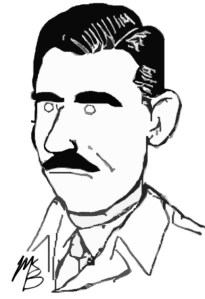
My unit won the award for me. I’m a permanent force man myself—Royal Canadian Regiment—but I would not want any tougher men with me than those New Brunswickers of our unit. On D-Day they were told to take certain objectives and they did just that.
(Vancouver Sun, 24 Oct 1944, 3)
Born on 1 July 1905 in Brockville, Ontario, Donald Bowie Buell was an RMC graduate, Permanent Force officer with the Royal Canadian Regiment, and instructor at RMC. His father, grandfather, great-grandfather and great-great-grandfather had all been colonels in the Canadian army. In late 1939, he transferred from RMC to be general staff officer with national defence headquarters. Overseas he was next appointed second-in-command of the North Shore Regiment and replaced Lieutenant-Colonel J.R. Calkin in September 1942.
After almost two more years training in England, Buell commanded the battalion during the landings on June Beach on 6 June 1944. He earned the Distinguished Service Order for his leadership that day and in the subsequent fighting in Normandy:
On 6 June 1944, as Commanding Officer of the North Shore (New Brunswick) Regiment, one of the assault battalions, this officer landed immediately behind his leading companies at Saint-Aubin-sur-Mer and continued to direct his battalion from among the forward troops during its advance inland.
As left assault battalion of the Brigade, North Shore (New Brunswick) Regiment had an exposed flank and in view of the fact that the battalion was also forming a firm base for the operation of a Commando Group, its progress inland was slower than the remainder of the Brigade, which was advancing on its main axis.
From the time of landing, the opposition at all stages was greater than expected and in carrying out his tasks, the widespread action of his unit made the work of Lieutenant-Colonel Buell all the more difficult. In spite of this, the battalion successively captured each position until its advance was halted by the enemy position at the Radar Station. The battalion was later ordered to by-pass this opposition and carry on to its final objective.
Throughout, Lieutenant-Colonel Buell was well forward with the leading companies directing and controlling the widespread operation. In doing this, he was forced to make his own decision as communications with Brigade were frequently broken, but he pressed on and showed great determination to carry out his Commander’s intention, thereby contributing greatly to the success of the operation. At no time did he spare himself in the performance of his duty and was an outstanding example to all ranks.
Shortly after the announcement of the award, Buell was severely wounded on 10 August 1944. Command of the North Shore passed to Major J.E. Anderson. Buell spent almost a year in hospital in England and Canada before being appointed to command an army training school in summer 1945. He was promoted to colonel as director of cadet training in 1954.
He died in Banff, Alberta on 22 July 1958 shortly before his scheduled retirement.
 World War Graphic History