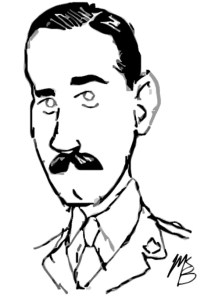
Lieutenant-Colonel Ian Macdonell
Queen’s Own Rifles
I don’t propose to be an alarmist … we must admit there is no point in us being ostriches. We are not preparing for what the Germans might do but for what we know they can do. Until we get organized there is no use in even giving an alarm, for nothing can be done.
(Kingston Whig-Standard, 29 Apr 1943, 2)
Born on 8 August 1895 in Toronto, Ian McLean Macdonell was a lawyer, former city alderman, and judge of the County Court of York. He was commissioned with the 41st Battery in December 1915 and deployed to France with the 11th Brigade, Canadian Field Artillery in July 1916. He was wounded in December 1917 and ended the war as staff captain with the 1st Canadian Division. He began a law practice in Toronto in 1920 and joined the Queen’s Own Rifles. After rising through the commissioned ranks, became commanding officer in April 1939.
Shortly after the regiment mobilized for active service, Macdonell was found medically unfit and relinquished command to Major H.C. Mackendrick in June 1940. “We are losing a fine gentleman and a great officer,” one member remarked noting that Macdonell had spend twenty years to bring the regiment “to the peak of perfection for this moment.” The former colonel accepted the change, stating, “All that matters is that the traditions of the regiment are safe. You know we were pretty worried for a time. We were afraid they’d forget all about us!”
Although out of uniform, the judge contributed to the war effort from the home front as vice-chairman of the Ontario Civilian Defence Committee. Believing that the province did not take the threat of enemy attack seriously, Macdonell defended Air Raid Precautions (ARP) of staged blackouts and alarm drills: “Many people think we should wait until the danger is upon us, and then they criticize ARP workers for losing their heads … There is too great a tendency to criticize those who are doing this work. Some say those who urge the work are extremists but the danger is a real one. ARP workers should be complimented not criticized.”
As a judge, Macdonell took a serve view of cases detrimental to the war effort. He rebuked a pair of Dutch refugees convicted of conspiracy to secure military service deferments: “If you were in Europe you would be in a concertation camp, if not something worse. You are not grateful to the country which gives you shelter, and you are not keeping faith with either the country or your own people.” In sentencing a Victory Bond thief to three years in a penitentiary, he warned, “I must make an example of you. The people who purchase these bonds, mostly poor people, have done so for patriotic reasons … There has been an epidemic of bond thefts and they must be stopped.”
In 1949, Macdonell was named to the Surrogate Court of York and he served on several royal commissions in the 1950s and 60s. He was honorary colonel of the Queen’s Own Rifles from 1956 to 1961.
He died in Toronto on 26 June 1992.
 World War Graphic History