Brigadier Fred Cabeldu
Canadian Scottish Regiment
4th Infantry Brigade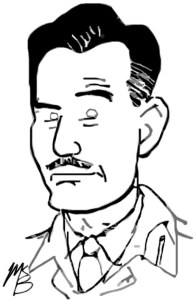
The steadiness and high morale of the 1st Battalion, The Canadian Scottish Regiment can be attributed to Lieutenant-Colonel Cabeldu’s calm handling of every emergency, his tireless devotion to duty and inspiring leadership under the most trying circumstances.
(D.S.O. citation, 31 Aug 1944)
Born in October 1905 in Hampton Wick, Middlesex, England, Frederick Norman Cabeldu grew up in Japan and was educated in Victoria, British Columbia. A partner in an investment firm in civilian life, he was commissioned in the Canadian Scottish Regiment in 1926 and rose to major. He became acting commanding officer in the absence of Lieutenant-Colonel Doug Macbeth in April 1943, and officially took over in August. Ten months later he led the battalion in the D-Day landings of 6 June 1944.
He earned the Distinguished Service Order for organizing a successful counterattack to consolidate the Normandy breakout position. A month later he was injured when an enemy shell hit battalion headquarters but returned to duty two days later. In August 1944, he fell ill with stomach flu and was replaced by Lieutenant-Colonel R.M. Lendrum. Cabeldu soon recovered and by the end of the month was promoted to brigadier of the 4th Infantry Brigade. He remained in command until the end of the war and earned a D.S.O. Bar:
At all times Brigadier Cabeldu exercised complete control, skilfully using supporting arms and quick to exploit any method or opportunity to hit the enemy harder or relieve a hard pressed situation. His frequent visits to his units in the midst of battle were always encouraging and his advice constructive. His enthusiasm was contagious and he has earned the absolute confidence of all ranks in his brigade. As a result of this commander’s outstanding leadership, good judgment, personal courage and exceptional resourcefulness, the Fourth Canadian Infantry Brigade is a fighting force ready and capable of handling any situation which may arise.
In 1947, he was elected city alderman in Victoria and served as chairman of the board of governors for the University School, which he had attended as a youth.
He died in Victoria on 12 June 1976.
 World War Graphic History
Pingback: On The War Memorial Trail…..The WWII Soldier From Caledonia Who Lost His Life During The Struggle To Capture The Goch-Calcar Road | On The War Memorial Trail Research Project…….. with Pieter and Daria Valkenburg