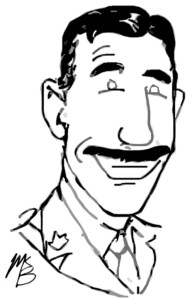
Lieutenant-Colonel Doug Macbeth
Canadian Scottish Regiment
But I’d much sooner be dead honorably, than beaten to death in a concentration camp, or have you in one because I wouldn’t take the chance. I’m not going to take foolish risks, but I’m going to do my job for my men, for my unit and for my home. It’s not an adventure. It’s a serious job … I’ll be back this time, too, mum darling. I have to get the lads home too, don’t I? So please don’t worry.
(J.D. Macbeth to Madge MacBeth, 1940)
Born on 28 September 1901 in Detroit, Michigan, John Douglas Macbeth had ancestors and relatives on both sides of his family who fought in every war in North America up to the Fenian Raids, the Riel Rebellion, and the Civil War. “With such a record,” his mother, American-Canadian author Madge Macbeth, wrote, “what chance had I, as a cowardly, peace-loving person, to wean Douglas away from a military career?”
By 1929, Doug Macbeth was lieutenant-colonel commanding the 3rd Canadian Division Signals Regiment. He reverted to the rank of captain to go overseas in September 1939 with the 1st Division Signals. “It feels strange to be saluting the colonels,” he wrote, “and standing respectively at attention, waiting to be called or spoken to. Good discipline, no doubt.”
He described the journey overseas to his mother, who worried for his safety, with patriotic pride:
The land faded away–the land we were going off to save for Democracy a second time, and suddenly the troops who had been singing and yelling went very still. Then, it would have brought a lump to your throat to hear them break into O Canada, their damp eyes glued to that little bit of haze, all that was left to us of the country we loved so well.
He wrote frequently to his mother, who published many of his letters as a pamphlet, Somewhere in England, in 1941, which described his experiences as an officer in the “waiting war.” After the invasions of the Low Countries in May 1940, he wrote that the “episodes bring the war pretty close to this country now, and I almost wish I were out in France again, where it’s safe. It’s an awful thing to contemplate, this beautiful country being any kind of battlefield.” Following the fall of France, England appeared next for invasion. “With the war at this stage, we never know when active duty will begin. Some people say, ‘Ah, a cloudy day. Just right for an attack.’ Others cry, ‘Ah, a clear day. Just right for an attack.’ Personally, I can’t think it will come.”
Macbeth expressed “unbounded confidence” in the British character to preserve with humour and the highest determination. “The people are the amazing thing about this war … That’s why I doubt the Germans will get very far with invasion. These people are not like the French or Belgians … I believe they will fight with pitchforks, catapults or stones if necessary.”
Macbeth was promoted back to lieutenant-colonel in November 1941 and took charge of the 2nd Divisional Signals. He was responsible for communications during the Dieppe Raid of 19 August 1942, for which he received the Croix de Guerre. He described the battle in a long and detailed letter to his mother, reprinted in the Ottawa Citizen:
… the General said, ‘Right. We go in,’ and in we went, towards the beach, all forward guns going. Swinging broadside, we let them have a salvo from everything on the ship—I even think the engineer threw this teeth at them. Shells answered promptly from the shore, whistled overhead and no so overhead …
Sure, I was scared. One would have had to be a moron not to have been. But it was like trying to hide under the bed during a thunder storm—what’s the use and you damn well know it …
My greatest worry was getting blown off the ship and taken prisoner, or of having to die without taking some of them with me … I sent you a straight cable as soon as I could …I wonder whether you could feel me thinking about you—tell me, and I might be able to save money on a cable next time. And there may be, we all hope, a next time.
In January 1943, he transferred to the infantry in command the Canadian Scottish Regiment, succeeding Lieutenant-Colonel R.G.L. Parker. But by August 1943 he was back in the Signals Corps and would go on to serve in Italy and Northwest Europe.
After the war, he resumed command of the 3rd Division Signals and then served as executive assistant to Veteran Affairs minister Milton Gregg. Macbeth died of a heart attack in Ottawa on 3 January 1951, at the age of only 47.
 World War Graphic History