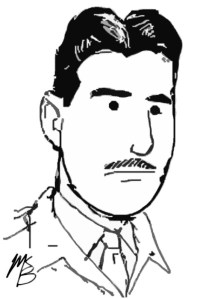
Major Gordon Brown
Regina Rifle Regiment
However, battle conditions place intolerable pressures on people, with unpredictable results. A hero today can fail tomorrow. A great leader last week can suffer from battle exhaustion this week.
(Brown, “Battle of Moyland Wood,” 101)
Born on 27 July 1918 in Manor, Saskatchewan, Douglas Gordon Brown went overseas as a reinforcement officer in June 1942 and joined the Regina Rifle Regiment. He was promoted to captain in January 1944 and received a promotion to “D” company commander shortly after landing on D-Day. Although twice wounded, he remained with the battalion for virtually the entire campaign in Northwest Europe and took temporary command of the Rifles in the final battle of the war at the end of April 1945.
Reflecting on the campaign from Normandy to the Netherlands, he noted, “The casualties in eight months of fighting had been horrendous. Regiments lacked trained and experienced officers and noncommissioned officers, and many soldiers had no battle experience. However. our greatest problem was attitude.” By early 1945, with Germany’s defeat almost inevitable, most for anxious for the end to come. Brown elaborated:
Those of us who had been with our units in England and since the invasion were near exhaustion. Some had been wounded once or twice and had returned to battle voluntarily, but they too were sick of the horrors of war. The gung-ho spirit of 1944 had been replaced with caution and apathy. We didn’t want to take unnecessary risks or to suffer casualties through errors, either on our part or on the part of higher command. This malaise affected all ranks, at least those on the battlefield and vulnerable to injury or death.
Despite the difficult circumstances, Brown proved himself an exceptional leader as company commander and temporary battalion commander, for which he earned the Distinguished Service Order:
In one period of ten days between 3 April and 13 April 1945, Major Brown led his company in no less than nine separate attacks, each in the face of heavy opposition and each resulted in many enemy dead. In these attacks his company accounted for a total of some 300 prisoners …
Throughout the entire period of his service Major Brown has displayed very great valour and extreme devotion to duty, and a constant cheerfulness under the most adverse conditions. The magnificent record of his company is a tribute to his powers of leadership.
On 29 April 1945, Brown took temporary command of the battalion when Lieutenant-Colonel Allan Gregory was assigned to 7th Infantry Brigade and second-in-command Major Bob Orr was away. He led the Regina Rifles in the last attack at the Leer bridgehead in Germany, resulting in death or capture of 200 enemy soldiers. Brown remained in command after VE-Day until returning to Canada in July 1945, remarking, “I’m anxious to get home and see a three-year-old son whom I have never seen.”
He published several recollections of his war experiences and a regimental history of the Regina Rifles. He died in Red Deer, Alberta on 13 May 2008.
The Capture of the Abbaye D’Ardenne by the Regina Rifles, 8 July 1944 , Canadian Military History, 4, 1 (1995): https://scholars.wlu.ca/cgi/viewcontent.cgi?article=1185&context=cmh
“The Battle of Moyland Wood”: The Regina Rifle Regiment, 16–19 February 1945, Canadian Military History, 6, 1 (1997): https://scholars.wlu.ca/cgi/viewcontent.cgi?article=1229&context=cmh
 World War Graphic History