Lieutenant-Colonel Jimmy Dextraze
Fusiliers Mont-Royal
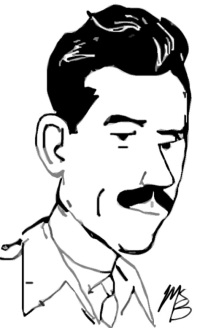
I love my province. I love my country. I don’t see Canada without the province of Quebec—or without Alberta or British Columbia. I went to combat to keep my freedom, to keep all we have as a country. As a Quebecois I also fought for Quebec when I went to combat … It sounds corny talking this way, you know, but maybe I’m a corny man. I’m a down-to-earth fellow.
(Quoted in Montreal Gazette, 14 Apr 1980, 10)
Born on 15 August 1919 in Montreal, Jacques Alfred Dextraze worked for a rubber company when he volunteered with the Les Fusiliers Mont-Royal in 1940. By 1942, he had been recommended for a commission and completed officer training at Brockville. He went overseas with a reinforcement draft after the losses the Fusiliers had suffered at Dieppe. By the time the battalion deployed to France in early July 1944, Dextraze had been promoted to major and “D” company commander. For “personal daring and determination,” leading his company in a hand-to-hand fight on 1 August, he earned the D.S.O.
In December 1944, Lieutenant-Colonel Paul Sauvé who had been re-elected to the Quebec assembly the previous summer, left to resume legislative duties. He handed command over to Dextraze, nicknamed Jimmy and Jadex, who would command the FMR to VE-Day. He remembered his predecessor as “a man of vision, one with the ability to get the very best out of everyone.” Sauvé’s desire “to get the French and English elements of Canada fully united,” had an impact on Dextraze.
In his New Year address to the men, in the final phase of the campaign, he called for them to live up to the legacy of French Canadians who served in the last war: “Etant Canadien-Francais nous sommes les heritiers de ces qualites militaires qui faisaient du Canadien un soldat qui rempilissait l’ennemi du crainte durant la derniere querre.” At Groningen, Netherlands on 15 April 1945, he earned a D.S.O. Bar for the defeat and eventual surrender of the German forces there:
Throughout the entire action Lieutenant Colonel Dextraze led his battalion forward, and when they were held up, he assisted and encouraged them onto their objective. The resourcefulness, superb courage, and devotion to duty of Lieutenant Colonel Dextraze was not only a great inspiration to his men, but the contributing factor in the final surrender of the garrison.
With the end of the war in Europe, Dextraze volunteered for the Pacific theatre. For his final official inspection of the battalion, the war diary described: “The parade was very solemn. The men were looking at their commander as if they wished. they could all talked to him. While passing though the ranks the Colonel did not speak much but the way he looked at his men was more than a speech.” Command passed to Major C.F.L. Roy, who led the battalion home in October 1945.
On demobilization, unable to find a position in the Permanent Force, Dextraze returned to civilian life. In 1950, however, he was recalled to military service as commanding officer of the 2nd Battalion, Royal 22e Régiment in the Korean War. He went on to a varied and active military and peacekeeping career.
In 1963, he was named chief of staff for the United Nations mission in the Congo. In one notable instance he led a helicopter rescue of peacekeepers and missionaries trapped by rebels. When asked about his willingness to take on difficult and dangerous assignments, he explained that he had no choice but to return to his “first love—the army.”
His son, Richard, joined with the US Marine Corps in 1967 and went to Southeast Asia in late 1968. Six months later, in April 1969, while on patrol in Quang Tri province, Lance Corporal Dextraze was ambushed and fatally wounded by machine gun fire. Reflecting on his son’s decision to enlist, General Dextraze stated years later: “It might sound corny coming from a 20-year-old fellow, but he told us, ‘I want to do my share. You fought in the last war for freedom and I’d like to go for a couple of years. When I come back I’ll feel a better man. I’ll feel I’ve contributed.’” The elder Dextraze added, “People say they were cranks, that they were stupid to go over there because it wasn’t our war. But this war was to fight a common enemy.” His son’s body had been returned home for burial.
He was Canada’s chief of defence staff from 1972 until retirement in 1977. During the 1980 Quebec referendum, he came out strongly in favour of the No vote, denounced sovereignty as folly, and advocated the importance of national unity. “I was never treated as an inferior,” he remarked of his army career, “and I never developed a bloody inferiority complex because of being a French-Canadian.”
Dextraze died in Montreal on 9 May 1993.
 World War Graphic History