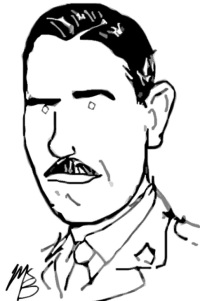
Lieutenant-Colonel Paul Sauvé
Fusiliers Mont-Royal
I realize that my absence may cause certain inconveniences. But as the war wears its way to the end—and it is the general conviction it will be this year—we much all of us realize the enormous task which awaits the government after the war.
(Montreal Gazette, 29 Jul Oct 1944, 9)
Born on 23 March 1907 in Saint-Benoît, Quebec, Joseph-Mignault-Paul Sauvé was a Université de Montréal graduate, lawyer, member of the Quebec Legislative Assembly since 1930. He represented Deux-Montagnes, succeeding his father, the former Quebec Conservative Party leader and senator. Defeated in 1935, he returned the next year as part of the newly formed Union Nationale Party of Maurice Duplessis and served as assembly president. Re-elected in the November 1939 election and speculated to be a potential new leader of the party, he instead would turn to military duties with Fusiliers Mont-Royal.
A reserve officer in the 2nd Battalion, FMR, he volunteered for overseas service in 1943. He assured those at home that morale among the troops remained high and the experience would well serve him in the future:
Yes, the young man who wishes to profit by what he learns for the benefit of his future and to serve his country well in the days of peace, if God see fit to keep his life, will return to his country with a valuable accumulation of knowledge. That is my hope, my desire, my will, and my determination. I would feel that my military value would be lessened if I did not have this after-war objective.
He became second-in-command in February and succeeded Lieutenant-Colonel H.N. Langlois in May. He temporarily led the battalion until handing it back to the previous CO, Lieutenant-Colonel Guy Gauvreau, shortly after it deployed to France on 7 July 1944. When Gauvreau was promoted to the 6th Brigade on 29 August, Sauvé took over the battalion again. In December 1944, he handed command to Major J.A. Dextraze, and returned home to resume legislative duties in Quebec months after his re-election.
During the August 1944 provincial election, Union Nationale leader Maurice Duplessis claimed that the Liberal government had agreed to not contest Sauvé’s riding of Deux-Montagnes. When the Liberals ran a candidate, Duplessis denounced Premier Adélard Godbout in the harshest terms:
Mr. Godbout has exhibited the white flag of truce to Paul Sauve who, confident that the Premier would be true to his word, has gone overseas … No sooner has Paul Sauve turned his back than he has cowardly shot him in the back.
We now find that Adolf Hitler—whose downfall we all hope and pray for—has found an imitator in the Province of Quebec in the game of tearing up sacred engagements and backing up on sacred promises.
As Sauvé’s senator father had died in February, management of the re-election campaign fell to his wife. She scorned “those who take advantage of Paul’s absence to satisfy their own personal ambitions.” In a letter to the voters, Sauvé vowed:
To dissipate all uncertainty and misunderstanding on the subject, I never had and have not now the desire to remain in the army after the war. I have but one desire–that of returning once the hostilities cease, and my presence here will not be necessary to serve my compatriots at home.
With Duplessis back in power, Sauvé joined his cabinet as Minister of Social Welfare and Youth. After Duplessis’ death on 7 September 1959, Sauvé succeeded to premier and announced a “100 Days of Change” plan to reform and modernize the province. However, he died after just 117 days in office from a heart attack on 2 January 1960.
His successor and final FMR commanding officer, Lieutenant-Colonel Dextraze, thought Sauvé would have been a great prime minister: “Paul’s great desire, which we often discussed in the dugout at night, was to get the French and English elements of Canada fully united. He often told me that one day he would do it. Unfortunately he died before he could make his dream a reality.”
 World War Graphic History