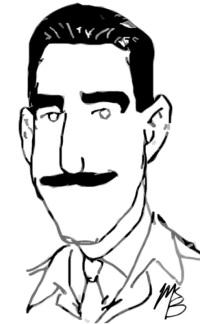
Brigadier Guy Gauvreau
Fusiliers Mont-Royal
6th Infantry Brigade
Nous vengerons enfin tous nos amis qui sont restés sur lese plages de Dieppe. La tache sera dure parfois mais soyez tous assurés que vos efforts ne seront pas sans recompenses.
Les nouvelles de tous les fronts sont bonne, l’avenir s’annonce plus encourageante que jamais; seulement, il faut tous y mettre la main si l’on veut voir la fin de cette guerre.
(Gauvreau, “Ordre du Jour,” war diary, 8 Jul 1944)
Born on 12 May 1915 in Montreal, Joseph Guy Gauvreau was road secretary for the Montreal Royals, the professional baseball club partly owned by his father and vice-president Colonel Romeo Gauvreau. He graduated from McGill University in June 1939 and mobilized as a lieutenant with Les Fusiliers Mont-Royal a few months later. He served in Iceland and in England as aide-de-camp to general Bernard Montgomery. Having missed the Dieppe Raid, he was recalled from home leave in September 1942 to take over the battalion from Lieutenant-Colonel Dollard Ménard who had been five-times wounded in the battle.
At 27 years old, Gauvreau was one of the young Canadian Army battalion commanders overseas. Of nearly 600 troops at Dieppe, the FMR had returned with just 125. Gauvreau rebuilt the decimated battalion over the next eighteen months. In February 1944, he relinquished command to Lieutenant-Colonel H.N. Langlois to attend the war staff college at Camberley, England.
The FMR deployed to France on 7 July 1944 under the command of Major Paul Sauvé, who had replaced a medically unfit Langlois. Gauvreau arrived from the staff course two days later to resume command. “A mon à retour l’unité comme commandant, je salue tous les officiers, sous-officiers et Fusiliers du bataillon,” he announced in his order of the day message. “Je suis honoré de vous commander de nouveau car je sais exactement de quel bois vous vous chauffez.” He told the troops the time had come to avenge the comrades who had fallen at Dieppe and reminded them to sustain the reputation of the regiment.
Within two months of fighting in the Normandy campaign, Gauvreau earned the D.S.O.:
His qualities of leadership were shown to be of high order. Frequently, with complete disregard for his own safety. He positioned himself to exposed places, so that he could carry out necessary direction of the operation and at the same time provide an incentive for all ranks to carry out their tasks. The success of the operation therefore can be attributed in high degree to his courage and inspiration.
By the end of August, Gauvreau took over 6th Infantry Brigade, replacing Brigadier F.A. Clift who had been wounded just days into stepping into the role himself. At 29, Gauvreau became the army’s youngest brigadier in the field. On 26 October 1944, he was badly wounded when his jeep hit a mine. Hospitalized for many months, he returned home in March 1945.
In addition to postwar military and civil defence service and business pursuits, he was as honorary colonel of Les Fusiliers Mont-Royal in the 1960s.
He died in Montreal on 5 May 1990.
 World War Graphic History