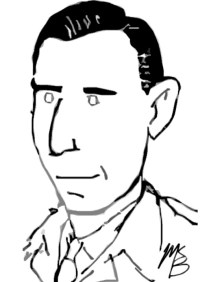
Major Buck Buchanan
South Saskatchewan Regiment
They were very convinced Nazis and felt that Hitler could do no wrong and that the disasters which had hit the German army were the result of politics. They thought the Jews and communists were responsible for everything.
(quoted in Leader-Post, 18 Nov 1944, 1)
Born on 13 March 1910 in Medicine Hat, Alberta, George Bruce Buchanan was postal clerk when enlisted as a private in the South Saskatchewan Regiment on mobilization in September 1939. He received a commission the summer before the SSR went overseas in December 1940. He served as captain adjutant under Lieutenant-Colonel Cecil Merritt during the Dieppe Raid of 19 August 1942 and, as he described, “I was one of the few men who made it back to England that day.”
Following the rebuilding and reorganization of the regiment, Buchanan served as company commander before transferring to 6th Infantry Brigade headquarters as intelligence officer. At the end of August 1944, SSR commanding officer Lieutenant-Colonel F.A. Clift was promoted to command 6th Brigade, while Buchanan left 6th Brigade to take command the SSR on 4 September. “Personnel who know Major J.B. Buchanan are very pleased to see him commanding the bn,” the war diary recorded, “and it is quite an honor to have one of our own men who joined as a Private commanding the bn.”
A week later he reverted to second-in-command, first serving under Lieutenant-Colonel B.R. Ritchie until he left to take over the Black Watch on 21 September, and then Lieutenant-Colonel Vern Stott who arrived the next day. As the SSR pushed through the Low Countries into Germany, Buchanan assumed temporary command while Stott was acting brigadier in early March. He was wounded by a grenade but had returned to take command during the final battles of early May.
Buchanan then temporarily commanded the Highland Light Infantry in the occupation of Germany and had to deal with a sit-down strike of soldiers protesting rations and prolong repatriation in early 1946. He returned home on discharge as a lieutenant-colonel in summer 1947. He returned to Dieppe for a memorial on the seventh anniversary two years later
Buchanan wrote the regimental history of the South Saskatchewan Regiment in 1956, The March of the Prairie Men:
The compiling of this book has indeed been a pleasure and has brought back to me many memories of associations with a good company of men … The responsibilities of leadership where men’s lives are at stake is a great one but the spirit of the S.Sask.R. was such that the load was shared all down the line of command from C.O. to newest N.C.O.
In the epilogue, he reflected on the legacy of the war for the volunteers:
The cost was heavy. Indeed, it is reported that the S.Sask.R. suffered among the highest unit casualties of the Canadian Army in the Second World War … It is those men who remain in Europe today who are responsible for the respect the Regiment holds in the military annals.
He died on 6 May 1997 Nepean, Ontario.
 World War Graphic History