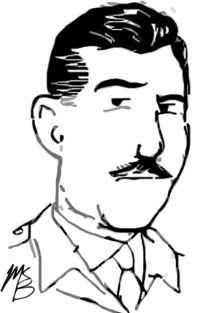
Lieutenant-Colonel Norman Ross
Queen’s Own Cameron Highlanders
Its all very well when you’re sitting down at your leisure reading it page by page and getting somebody else’s opinion two weeks later and comparing this and comparing that. But in the confusion of battle and everything that’s going on and trying to put it together … Bang, bang, bang … Much more difficult.
(Ross interview, 20 Jul 1979)
Born on 5 June 1915 in West Kildonan, Manitoba, Norman Hugh Ross attended the University of Manitoba and worked for an insurance company in Winnipeg. Having belonged to the Cadet Officer Training Corps at university, he took a commission with the Queen’s Own Cameron Highlanders before the war. He led the advance party of the regiment to England in June 1940 and became company commander overseas after the removal of many overage senior officers. “By this time the glamour of their ribbons and their World War I experience had worn off,” Ross said. “And they had out served their usefulness really.”
Ross served as “A” Company commander during the Dieppe Raid of 19 August 1942. “Like all troops going into battle for the first time,” he recalled before making landfall, “Your heart is in your mouth, a little lump in your tummy, and things like that.” He led his company ashore under heavy fire and would soon learn that Lieutenant-Colonel A.C. Gostling was killed immediately on hitting the beach. As Ross later reflected of the legacy of the raid:
I don’t consider Dieppe to have been a great failure, sure it was a failure but many operations of war were a failure, you don’t win them all. As long as you win the last one. So there are books written on Dieppe, some of them I won’t even read … a lot of garbage …
We were ready for it. We wanted it. Sure we wanted it. It was high time we got something. If we’d gone right through Normandy, we’d been stale. We’d have more trouble, we’d have a demoralized army I think. We were ready for Dieppe. We were well trained for Dieppe. Why shouldn’t we have Dieppe? Why give it to someone else? I think whoever got it for the Canadians did absolutely right … Give us this show. And if you’re going to give it to us make it ours. Period. Make it Canadian, all Canadian. We want it.
In February, he succeeded Lieutenant-Colonel Andy Law, who had been removed for inefficiency of the unit. “I had to do what Andy Law should have done and what I kept telling him he should do,” Ross said of the need to fire underperforming subordinates. “But he didn’t have enough intestinal fortitude to do it.” On taking over, Ross removed a major, two lieutenants, and the longtime regimental sergeant major and the company sergeant major. Ross reflected on these difficult personnel decisions: “Its a responsibility of command, its a responsibility of management, whatever you want to call it in civil life, but certainly in military terms its the responsibility of command that you must face up to.”
Five months later, the Camerons deployed to Normandy. “We were getting shelled. Minnies were coming over. Our first exposure to the Moaning Minnies and whatnot,” he described of the first night under enemy fire. “Some of us had been through Dieppe but that was our only previous experience … We were a little on edge you might say!” On 22 July 1944, while driving back to battalion headquarters his jeep was struck by an 88 shell, killing the driver and leaving Ross badly wounded in the leg. “Blood squiring all over the goddamn place,” he was eventually rescued and evacuated to hospital. He earned the D.S.O.
In a cast for the next two years, Ross returned to home but volunteered for available duties. In 1946, he was made head of the army discharge review board in Ottawa, tasked with assessing all dishonourable discharges over the course of the war. “We got a lot of satisfaction out of righting some of the wrongs,” Ross noted of the board’s work:
We found for instance, Canadian men, young men, who had volunteered, gone overseas, gone into battle, had fought many battles, their nerve gave out, couldn’t go forward, couldn’t get out of a slit trench anymore to go forward, were carrying with them a dishonorable discharge and could not get work. In comparison to somebody who did not volunteer, who had no discharge certificate … we felt this totally unfair.
Ross joined the regular army after the war, serving in Washington, D.C., Tokyo, and London, in addition to postings across Canada. He was deputy chief of general staff and head of the intelligence and security branch by his retirement in 1970.
He died in Victoria, British Columbia on 3 June 2005.
 World War Graphic History