Lieutenant-Colonel Gil Dudley
Queen’s Own Cameron Highlanders
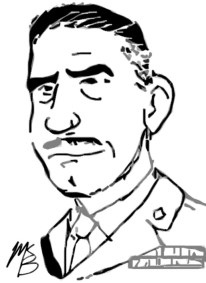
It was a much different enemy the Canadians were facing in this war, he said. The Germans had studied the weaknesses which made them lose the last war, and were a much more efficient fighting force. However, the Canadian troops overseas had proven apt pupils, and now could teach the Germans a thing or two.
(quoted in Winnipeg Tribune, 6 Oct 1942, 18)
Born on 23 April 1885 in Dumfries, Scotland, Guildford Francis Dudley served with the 1st Royal Scots in the Boer War and moved to a ranch in Alberta in 1904. Having enlisted in the Fort Garry Horse in September 1914, he reverted from sergeant to the rank to join the 8th Battalion in France in August 1915. He earned the military medal and was subsequently commissioned in December 1916. He received the Military Cross in July 1917 and ended the war at the rank of captain. He served as commanding officer of the Winnipeg Rifles from 1927 to 1934.
Although by now retired to the reserve militia list, Dudley offered his services again with mobilization in September 1939. He joined the Queen’s Own Cameron Highlanders as second-in-command to fellow First World War veteran Lieutenant-Colonel Hugh Mackenzie. The regiment went overseas in December 1940, but Mackenzie relinquished command to Dudley for medical reasons in February 1941.
Major Norman Ross, who would command the Camerons in Normandy, recalled of Dudley, “He wanted to get into the thick of things … He had MC, MM, a DCM or something like this, he had a lot of ribbons on. Hell of a nice guy and a good soldier. It wasn’t until after we actually found out he also fought in the Boer War as a boy soldier or something, but he’d taken down his Boer War ribbon, taking it off.” New army policies had determined to remove officers over the age of forty-five. As a South African War veteran, Ross well exceeded this limit.
As the Camerons trained for the eventual Dieppe landings, in early 1942, Dudley suffered injuries in a training accident and relinquished command to Major A.C. Gostling, who would be killed in the raid. Medically unfit, the 57-year-old veteran of two wars returned home in April 1942. He served various duties including instructor for a United States Reserve Army’s senior officers’ school, liaison officer for the Winnipeg military district, and member of the officer selection and appraisal board in British Columbia.
In 1945, he joined the Department of Veteran Affairs until retiring eight years later. He died in Winnipeg on 29 October 1968.
 World War Graphic History