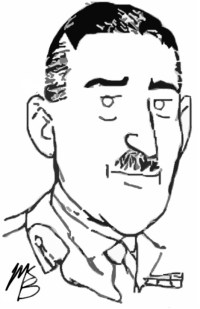
Lieutenant-Colonel Fred Scott
Calgary Highlanders
Perhaps the person reading this Diary right now has become rather fed up with my constant reference to Battle Drill but perhaps if you continue on reading this Diary and come to the day, say a year or two from now, and read “The Calgary Highlanders captured an important enemy position by a machine-like pincer movement” you will see why I have stressed so much this type of training.
(War diary, 31 Dec 1941)
Born in Meaford, Ontario on 3 July 1892, James Fred Scott enlisted with the 89th Battalion in 1916 and served with the Royal Flying Corps before returning to the infantry with the 50th Battalion in France. He was struck off strength to Canada with a diagnosis of trench fever in summer 1917. Following demobilization, he completed a law degree in Toronto and passed the Alberta Bar. Commanding officer of the 15th Alberta Horse since 1936, in September 1939, he succeeded Lieutenant-Colonel H.H. Riley of the Calgary Highlanders, who had been declared medical unfit for active service.
The regiment went overseas in August 1940, and in the United Kingdom, Scott fully embraced the training scheme known as Battle Drill. He put the Highlanders through exercises that aimed to simulate real battle conditions. A passionate advocate of the idea, Scott with some difficulty sold the concept to Canadian Army leadership, spreading Battle Drill more widely in the overseas forces. Scott enthused: “It was the answer to everything that was needed to make the individual soldier man of initiative and as apart of a perfect fighting machine.”
Hoping to remove the monotony of ordinary training, Scott looked for novel ways to harden the troops including having them visit slaughterhouses and medical operations. Another exercise involved men dressed up with pig’s blood and torn uniforms to prepare stretcher bearers for treated badly mangled casualties. “We are all sure that when the test comes,” Scott remarked, “—as it most assuredly must come—the Canadian Corps will live up to the traditions of the old CEF in the last war.” The colonel put himself through the rigorous battle drilling he expected of his men.
In February 1942 Major D.G. MacLauchlan replaced Scott, who was recalled to Canada. He served as general staff officer at the Royal Military College before being given the opportunity to put his ideas into practice at the battle drill training school in Camp Vernon, British Columbia. Instructors described the obstacle course in Devil’s Gulch full of trenches, barbed wire, and wooden barriers as Scott’s “weird dream.”
The press tended to fixate on a popular misconception of commando training even as Scott tried to temper some of the exaggerated reporting on his implementation of Battle Drill. He described the main objectives were, “physical fitness, battle discipline, a training laboratory, common doctrine, detail, speed, enthusiasm, mass production, battle inoculation—Realism.”
Returning to a legal career after the war, Scott died on 13 February 1982.
 World War Graphic History