Lieutenant-Colonel M.L. de Rome
Régiment de Maisonneuve
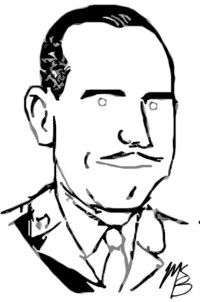
Lieutenant Colonel de Rome has, during the last 8 months, trained and commanded with outstanding success the Special Force Detachment attached to H.Q., Canadian Army. His quick grasp of the unusual problems involved, his application, enthusiasm and drive, have been an inspiration to all ranks, British and Canadian, in his Detachment.”
(O.B.E. citation, 19 Apr 1945)
Born in Ottawa on 8 January 1911, Maurice Louis de Rome belonged to the Cadet Officer Training Corps at the University of Montreal and joined the Régiment de Maisonneuve in 1935. He joined the Royal 22nd Regiment on mobilization in September 1939. Then in July 1942, he succeeded Lieutenant-Colonel J.R. Roche in command of the Maisonneuve regiment. His tenure would be brief and returned to Quebec in November 1942. However, he would soon be assigned to more secretive and sensitive duties.
Attached to the Special Operations Executive (SOE), de Rome trained in the arts of espionage and participated in the planning and execution of resistance efforts in occupied France. From flooding the country with false ration books to more destructive efforts of sabotage, the SOE coordinated subversive activities to disrupt and harass the enemy. “The is form of warfare was often more accurate and less costly in human life than bombing,” de Rome later reflected.
After D-Day on 6 June 1944, he was attached to Canadian Army headquarters as the Special Forces Detachment representative responsible for clandestine operations during the advance from Normandy into the Low Counties. For his contributions to the war effort, he was honoured by Canada, the United Kingdom, the United States, France, and the Netherlands. His Presidential Medal of Freedom citation read:
by his complete devotion and organisational and executive skills made outstanding contributions in the implementation of Special Force Detachments, both British and American, for the direction of Resistance Groups in enemy occupied territory in support of military activities. His efforts contributed in large measure, to the successful invasion of the Continent by the Allied Expeditionary Force and the resulting liberation of France.
De Rome joined the staff of Prince Bernhard of the Netherlands and served as military attaché to Belgium and the Netherlands until 1948. On return to Canada, he held various military postings in Quebec, Ontario, Alberta, and Manitoba through the 1950s.
Speaking of his wartime experiences, he told a Calgary audience while commandant at the Currie Barracks in 1954:
Wartime espionage, far from being the thrilling cloak-and-dagger existence pictured by the movies, is a tough, grueling and sometimes tedious part of the general plan of military operations.
He died in Montreal on 4 December 1967.
 World War Graphic History