Brigadier K.D. Blackader
Royal Highlanders of Canada (The Black Watch)
8th Infantry Brigade
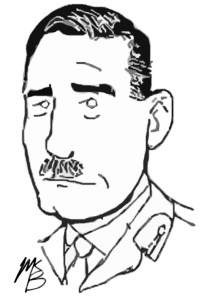
Throughout the initial and subsequent phases, Brigadier Blackader ceaselessly and tirelessly fought his brigade with skill and great determination. Without regard to his person, he visited all his units and by his word and deed was an inspiration to his command. Brigadier Blackader’s example is worthy of the best traditions of the army.
(D.S.O. citation, 31 Aug 1944)
Born on 19 December 1898 in Montreal, Kenneth Gault Blackader enlisted in 1916 as a lieutenant in a reinforcing draft for the Royal Highlanders of Canada. He joined the 13th Battalion in France, was wounded in September 1918, and earned the Military Cross. He became commanding officer of the 1st Battalion, Royal Highlanders of Canada in 1934 and was elevated to regimental commandant of the Black Watch in 1938. The next year he reverted to take the 1st Battalion overseas following mobilization.
He tenure with the Black Watch overseas lasted from departure in August 1940 until his promotion to brigadier in January 1942. “The Col. formed the Bn. and has directed its destines for two years,” one soldier wrote, “and now will never take us into action.” He impressed General Bernard Montgomery as a first-class commander with potential for advancement. Blackader led the 8th Infantry Brigade for the next two and a half years in the lead up to the invasion of Normandy.
On 6 June 1944, the 8th Brigade, comprising the Queen’s Own Rifles of Canada, Le Régiment de la Chaudière, and the North Shore (New Brunswick) Regiment landed at Juno Beach. In recognition of his leadership in the assault and breakout from Normandy, he earned the Distinguished Service Order:
Throughout the day Brigadier Blackader lent great encouragement to all his commanders and troops by his presence and great determination to reach the objective set to his troops. By the end of D-Day the 8th Canadian Infantry Brigade has reached its objective—the capture of ground vital to the Corps plan.
He led the brigade through the battle of Calais and took temporary command of the 3rd Canadian Division in mid-August after the wounding of Major-General Rod Keller. After nearly four months of continuous fighting since D-Day, by the end of September 1944, he was hospitalized and posted back to England.
He was assigned to the 13th Training Brigade and later acting commander of the Canadian Reinforcement Units. Although his active combat service was finished, these duties were recognized with an Order of the British Empire:
In this task he has further demonstrated his experience, ability and continual consideration for the welfare of those under his command. By his gallant service in the field, his outstanding contribution to the training of infantry reinforcements and his high standard of command and administration of his Repatriation Groups, Brigadier Blackader has made a very great contribution to the general efficiency and well-being of the Canadian Army.
He retired from the army in 1946 and resumed a civilian accounting career but became colonel of the Black Watch in 1951. He died in Montreal on 28 April 1967.
 World War Graphic History