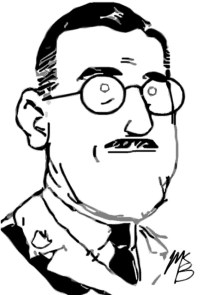
Lieutenant-Colonel Bruce Macdonald
Essex Scottish Regiment
This case, the first of its kind to be tried in a Canadian Military Court, is of considerable importance, not only in that it concerns the murder of a large number of Canadian prisoners of war; but also, in that it is the first occasion …in which an effort will be made to establish, not only the immediate responsibility of a high ranking officer, for atrocities committed under his order, but also his vicarious responsibility for such crimes, committed by troops under his command, in the absence of a direct order.
(Macdonald opening address, Kurt Meyer on Trial, 97)
Born on 2 December 1902 in Rose Bay, Nova Scotia, Bruce John Stewart Macdonald held a law degree from the University of Alberta and was a prominent lawyer in Windsor, Ontario. Having belonged to the Essex Scottish Regiment since 1929, he went overseas as a company commander but later returned for instructional duties. Having missed the Dieppe Raid which virtually annihilated the regiment, Macdonald became second-in-command and succeeded Lieutenant-Colonel John Mothersill in May 1943.
Rebuild since the losses at Dieppe almost two years earlier, the Essex Scottish deployed to France again with the 2nd Division on 5 July 1944. Less than three weeks later Macdonald was unceremoniously sacked for nerves and insubordination. Brigadier H.A. Young of the 6th Infantry Brigade held him responsible for heavy losses at Verrières Ridge during Operation Atlantic on 20 July. He in turn blamed contradictory orders from higher command for operational problems. “All the rules of man management were either violated or ignored, by the sudden move ordered after mid-night,” the Essex war diary recorded, “the loss of sleep by all ranks, a poor breakfast and little or no noon meal before battle, and the general or detailed picture and plan, if known, was not given to the junior offrs or troops.”
By contrast, the 6th Brigade war diary reflected Young’s perspective: “Col Macdonald, the OC came to the Comd Post several times during the evening. Bde Comds orders were made very clear to him but he seemed to have lost complete control and was himself in a very excited and nervous condition.” Having lost confidence in Macdonald in the first major action, Young relieved him of command in favour of Major T.S. Jones.
Macdonald protested his removal, writing to General Charles Foulkes, “My feelings were less nervous than frustration and suppressed anger at [Young’s] impatient attitude toward me and my inability to move him.” He expressed little faith in the brigadier’s attack plan, explaining, “psychologically everything was wrong and as far from what might have been imagined as the proper preparation for their first battle.” In his final address to his “boys,” who had all signed a letter of confidence, the now former commander declared:
Despite my most strenuous efforts, and your much appreciated assistance, I have been unable to avert this result, and am being transferred to another command. This is a bitter disappointment to me, but I cannot quarrel with an army practice that holds a unit commander responsible for anything that goes wrong in his unit, despite his efforts to prevent it. It is for your protection partly that such a rule exists.
Although Macdonald failed to have his removal overturned, he was reassigned to the Supreme Allied Expeditionary Force headquarters, where he took a leading role in war crime investigations. He served as chief prosecutor in the December 1945 court martial of Kurt Meyer for complicity in the murder of Canadian prisoners of war. In his closing address, he argued for the justice of holding Meyer accountable for the actions of his SS troops:
We cannot produce a photograph of the accused standing over the dead bodies of prisoners with a smoking pistol in his hand, nor can we produce verbal evidence to the same effect. That sort of thing doesn’t happen … But we are doing something better than that, we have brought before you the officer in whose mind was hatched these crimes to be executed by others. He is the greater menace, and the one in such case to be held responsible and above all others to be punished. Punishment applied to him will be punishment directed to the source, and the greatest possible deterrent for the future.
Although he secured a conviction and a death sentence, Macdonald was disappointed in Meyer’s commutation to imprisonment: “It seemed to question the usefulness of any effort to establish responsibility on any level above that of the actual perpetrator, and was discouraging to all of us who had laboured so arduously over a long period in the field of war crimes.” Even so, Macdonald’s insistence on a review and confirmation of the sentence, led him to later assume, “it was only by, I would say, my intervention that he wasn’t executed.”
Macdonald resumed his law career after the war and in 1951 became crown attorney for Essex County. From 1961 to 1977, he was an Ontario court judge and then a small claims court judge until his death in Windsor on 2 June 1986.
For more on the context around his removal from command see: John Maker, “The Essex Scottish Regiment in Operation Atlantic: What Went Wrong?” Canadian Military History, 18, 1 (2009): https://scholars.wlu.ca/cmh/vol18/iss1/3/
For more his role in Kurt Meyer’s trial see: Taylor Coates, “Bruce John Stewart MacDonald: just the man for the job,” Nipissing University MA thesis, 2020. https://tspace.library.utoronto.ca/handle/1807/102484
 World War Graphic History