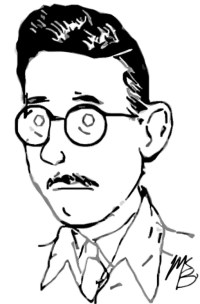
Lieutenant-Colonel Fred Jasperson
Essex Scottish Regiment
And how magnificently you have supported those soldiers, all those who have gone from this community into the services, I know from personal experience, and there are thousands to bear witness to this, that we never wanted for anything you could give us, the greatest of which was that intangible thing, morale—the very fibre and life of a soldier—morale. You gave it to us by the real love and marvelous generosity of your hearts.
(Quoted in Windsor Star, 25 Jul 1945, 6)
Born on 16 July 1900 in Kingsville, Essex, Ontario, Frederick Kent Jasperson was a lawyer, fiction writer, and scholar, having attended the University of Toronto, Columbia Law School, and Osgoode Hall. Active in the militia, he had belonged to the 48th Highlanders of Toronto and was commissioned in the Essex Scottish as he started a law career in Windsor. As third-in-command, he led the regiment overseas in summer 1940, following the advance party of Lieutenant-Colonel A.S. Pearson and second-in-command J.H. Mothersill.
By January 1942, the First World War veterans Pearson and Mothersill had stepped aside for Jasperson to take over the Essex Scottish. Within a few months, the battalion began intensive training for an amphibious operation. On 19 August 1942, Jasperson led his troops ashore at Dieppe in the raid that would virtually annihilate the unit. In initial press reports, the colonel was reported missing and presumed killed.
Believing his colonel likely dead, the one unwounded Essex captain to escape the beach wrote an open letter to Japerson’s wife, reprinted in the Windsor Star:
From my own experience I know that Colonel Jasperson thought not of himself during the action but bent every effort to assist his troops. He gave leadership every inch of the way … I do offer to all of you my deepest sympathy for your great loss … I personally am proud beyond words to have been privileged to serve with Colonel Jasperson and his gallant officers and men.
The colonel had in fact survived but was one of hundreds captured. “Too bad we’re here, but our effort was worth it,” he wrote to his wife from a prison camp in Germany. “Quite a show never to be forgotten. I am safe and at present basking in sunshine … Love to all, keep your chin up.”
After over two and a half years as a prisoner of war, Jasperson along with fellow 4th Brigade colonels Doug Catto of the Royal Regiment of Canada and Bob Labatt of the Royal Hamilton Light Infantry were liberated by the US 3rd Army in May 1945.
Health depleted after long imprisonment, Jasperson tried farming, writing, and politics in the years after the war. He unsuccessfully contested the riding of Essex South for the Progressive Conservatives in the 1949 federal election. In that same campaign, the final wartime commanding officer, Lieutenant-Colonel Kenneth MacIntyre, also lost in Essex West. In 1953, he was named an Ontario magistrate and retired as a judge in 1969.
He was killed in a car accident on 17 May 1982.
 World War Graphic History