Lieutenant-Colonel H.C. Arrell
Royal Hamilton Light Infantry
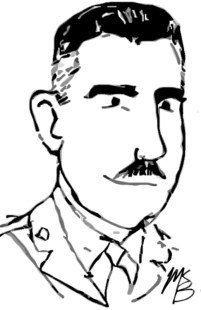
Major Arrell held court on the top floor of the convent. He explained to the attentive soldiers that their role was to stop the enemy if he attacked from the north. At all costs, they were to stop the Germans from overwhelming allied positions and gaining ground around Tilburg, Antwerp and Brussels. “In brief,” said a calm but somber Arrell, “we are a stand and die battalion, totally committed to stopping the enemy.”
(Kelly, “There’s a goddamn bullet for everyone …”, 285)
Born on 18 March 1914 in Caledonia, Ontario, Hugh Cameron Arrell graduated from the Ontario Agricultural Collage in Guelph and belonged to the Dufferin and Haldimand Rifles. In April 1940, he transferred as a lieutenant to the Royal Hamilton Light Infantry which went overseas that summer. He was promoted captain less than two years later and deployed to France with the regiment as a major in July 1944.
After a quick succession of commanding officers over the next month, Arrell took temporary command on 28 August 1944 when Lieutenant-Colonel G.M. MacLachlan fell ill. He led the battalion during an attack the next day but by the end of the month Lieutenant-Colonel B.R. Ritchie arrived from The Black Watch to take up command.
In his novelized memoir, “There’s a goddamn bullet for everyone …”, RHLI corporal Art Kelly, has his protagonist ask, “Why in the hell didn’t they make Arrell the unit commander?” This fictionalized account depicted the major as a blunt leader who still cared for those under his command:
“Up to now,” specified Arrell, “this regiment of ours has suffered over four hundred casualties. Most of the poor bastards out there are reinforcements who have had little or no infantry training. All this has happened because Intelligence makes bad errors …”
Former RHLI commanding officer Lieutenant-Colonel Denis Whitaker resumed command on 15 September 1944 and Ritchie left to take over the South Saskatchewan Regiment. Arrell continued to serve as second-in-command for the next eight months as the battalion advanced through northern France into the Low Countries. When Whitaker was promoted at the end of March 1945, Arrell officially took over and led the RHLI during the final drive into Germany. He then led the regiment home to Hamilton in November 1945.
Following demobilization, he completed a law degree at Osgoode Hall. In 1952, Arrell was appointed magistrate in Hamilton and became judge in the city’s juvenile and family court the next year.
He died of a heart attack in Toronto on 10 December 1967.
 World War Graphic History