Lieutenant-Colonel G.M. MacLachlan
Royal Hamilton Light Infantry
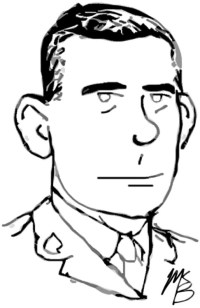
No scheme we ever did is anything like this for toughness, not so much in the sense of great forced marches but in the way of continual work, alarm, fatigue and nerve strain and unlimited dirt, cold and wet.
(MacLachlan letter, 23 Jan 1943)
Born on 4 June 1914 in Winnipeg, Graham Martin MacLachlan was a University of Toronto graduate, lawyer, and militia captain with the Royal Regiment of Canada. In January 1943, he was one of several Canadian officers selected to gain combat experience with the British Army in North Africa. After joining the 5th Battalion, Royal East Kent Regiment (The Buffs) in Tunisia, he wrote to a friend “Things have worked out wonderfully. I took a 2 1/c and at once stepped into a bit of fun. This bn is good and I have learned as much in 5 days as one learns in 3 mths in England.”
From February to March 1943, he was attached to the 1st Battalion, Royal Irish Fusiliers, whose colonel considered MacLachlan and two other Canadian officers “first class in very respect.” The brigadier of the 38th (Irish) Brigade reported of his performance: “He took the keenest interest in all that he was shown, and took the greatest pains to make himself fully conversant with the organization of Bn. H.Q. and H.Q. Coy. He has fully absorbed valuable war experience in this theatre, and carried out his duties in a very satisfactory manner. I consider Capt. MacLachlan to be fully capable of performing the duties of his rank.”
After his North African experience, MacLachlan left the Royals to attend the war staff college. He then transferred to the Royal Hamilton Light Infantry as the new second-in-command just after the 2nd Division landed in France on D-Day. When Lieutenant-Colonel W.D. Whitaker suffered a shell wound on 14 July, he temporarily over until the arrival of Lieutenant-Colonel J.M. Rockingham a few days later. When Rockingham was promoted to brigadier on 4 August, MacLachlan took command of the RHLI again.
His tenure would again be brief. He suffered a minor wound on 12 August when a mortar bomb struck his command vehicle. Several soldiers were killed and as a result of shock, MacLachlan “appeared to have lost some of his old self-confidence.” When ordered to prepare an attack for 28 August, he broke down and needed to be evacuated through medical channels. In a candid letter to Major-General Charles Foulkes of 2nd Canadian Division, MacLachlan admitted:
I realize that I will not and could not command again after twice collapsing at vital times. I ask you in your thoughts towards me to balance against yesterday’s episode the previous successful actions of the RHLI since Verrieres so that my contribution to 2 Cdn Inf Div will have a credit side.
Major H.C. Arrell took over the next day but by the end of the month Lieutenant-Colonel B.R. Ritchie, second-in-command of The Black Watch, had been appointed to command the RHLI.
MacLachlan took on instructional duties in the United Kingdom until the end of the war. He retired from the army in 1945 and embarked on a successful business executive career. By 1963, he had become president of Maple Leaf Mills Limited. He died in 1982 and is buried in Toronto’s Mount Pleasant Cemetery.
 World War Graphic History