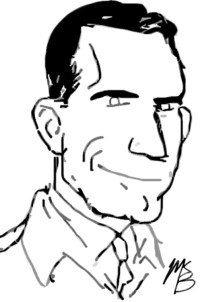
Lieutenant-Colonel Denis Whitaker
Royal Hamilton Light Infantry
The ramp dropped. I led the thirty odd men of my platoon in a charge about twenty-five yards up the stony beach. We fanned out and flopped down just shorty of a huge wire obstacle. Bullets flew everywhere. Enemy mortar bombs started to crash down. Around me, men were being hit and bodies were piling up, one on top of the other. It was terrifying.
(Whitaker, Dieppe: Tragedy to Triumph, 243)
Born on 27 February 1915 in Calgary, William Denis Whitaker was a sportsman, soldier, equestrian, businessman, and historian. After attending the University of Toronto and RMC, where he excelled in hockey and football, he played quarterback for the Hamilton Tigers in the Ontario Rugby Football Union in the 1937-39 seasons. Having joined the city’s militia regiment, he mobilized for active service with the Royal Hamilton Light Infantry and went overseas in 1940. He would be one of the only officers to land at Dieppe and escape the beach unwounded.
On 19 August 1942, he led his platoon toward the town under heavy fire but was soon pinned down. “It was impossible to move, as the mortaring continued without interruption,” he later explained. “We lay in this crap for twenty or thirty minutes, feeling great revulsion for every German alive.” When ordered to withdraw in the face of this counterattack, he evacuated much of his unit even as Lieutenant-Colonel Bob Labatt was taken prisoner. On arrival back in England, Whitaker met the battalion adjutant devastated by the losses. “The one officer in the battalion who had come through the battle without being wounded, killed or captured, hugged him, weeping freely. That officer was me.”
Recommended for the D.S.O., his citation read in part: “He was at all times calm and cool, directing with great genius the movements of the troops under his command, and displayed great courage and initiative. His actions were an inspiration to all.” As the regiment reorganized from the decimation of its senior ranks, Whitaker gained a promotion to major and served as second-in-command under Lieutenant-Colonel J.M. Rockingham.
He took over the RHLI in February 1944 when Rockingham was sent for a course at the war staff college. Four months later Whitaker led the regiment to France with the deployment of the 2nd Division to the European theatre on 6 July. Within a week enemy shelling struck his dugout. Wounded in the face, Whitaker was evacuated and soon replaced by Rockingham who arrived in France a few days later.
After a two-month recovery, Whitaker resumed command on 15 September 1944 succeeding Lieutenant-Colonel B.R. Ritchie, who took over the South Saskatchewan Regiment. RHLI veteran Arthur Kelly wrote “Whitaker was tough and could be a mean bastard, but the men all like him. He was brave, knew what he was doing and most importantly, he was up front where the action was.”
He led the regiment through the liberation of the Netherlands until the end of March when he was recalled to England and promoted to colonel. He had earned a D.S.O. Bar for holding a captured position against relentless counter attacks in February:
Whitaker was the full master of the occasion, and with inspiring leadership and great tenacity restored situation after situation by cool and deliberate planning, until a resolute enemy was forced to abandon a prearranged plan to retake the position due to the heavy casualties suffered in both armour and infantry … Whitaker’s cool courage under heavy fire was an inspiration to all ranks and will live forever in the annals of the Regiment.
He retired from the army in 1951 with the rank of Brigadier and served as honorary colonel of the RHLI from 1972 to 1992. Remaining active in sports, he rejoined the Hamilton Tigers for the 1945-46 seasons and chaired the Canada’s Equestrian Team to multiple international championships over two decades. He was chef-de-mission for the 1980 Canadian Olympic Team in Moscow before Canada and the United State boycotted du to the Soviet invasion of Afghanistan.
In retirement Whitaker wrote several accounts of the Second World War with his wife Shelagh. Their many titles included: Tug of War: The Canadian Victory That Opened Antwerp, (1984), Rhineland: The Battle to End the War (1989), Dieppe: Tragedy to Triumph (1992) and Victory at Falaise: The Soldiers’ Story (2000) and Normandy: The Real Story How Ordinary Allied Soldiers Defeated Hitler (2000).
Whitaker died in Oakville, Ontario on 30 May 2001.
 World War Graphic History
Sorry to be the typo weenie but “He led the regiment trough ***[through]*** the liberation of the Netherlands until the end of March when he was recalled to England and promoted to colonel. He had earned a D.S.O. Bar for holding a captured position against relentless counter attacks in February:
Whitaker was the full master of the occasion, and with inspiring leadership and great tenacity restored situation after situation by cool and deliberate planning, until a resolute enemy was forced to abandon a prearranged plan to retake the position due to the heavy casualties suffered in both armour and infantry … Whitaker’s cool courage under heavy fire was an inspiration to all tanks ***[ranks]*** and will live forever in the annals of the Regiment.
My uncle was killed under his command in the action mentioned, Goch-Calcar Road. February 19, 1945.