Lieutenant-Colonel Jack Anderson
Royal Regiment of Canada
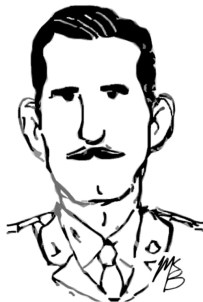
In spite of his own wound and under most intense fire which struck down many men as the beach was reached, Capt. Anderson organized the landing of all unwound personnel and a three-inch mortar with its ammunition. This officer displayed high qualities of leadership coolness and determination under most difficult circumstances.
(M.C. citation, Oct 1942)
Born in Toronto on 10 October 1909, John Charles Holtby Anderson was a bond house executive and since 1931 was a commissioned officer with the Toronto Regiment, redesignated the Royal Regiment of Canada in 1936. He served as captain of a landing craft during the Dieppe Raid of 19 August 1942. Under heavy enemy fire as the troops came ashore, Anderson manned a Bren gun even as he sustained shrapnel wounds to the head.
Anderson was one of the few Royals to escape the beach when the regiment was overwhelmed. He received the Military Cross for his gallantry and became second-in-command by the regiment’s return to France in July 1944.
Only a week after landing, on 15 July, Lieutenant-Colonel A.M. Young was relieved, and command of the Royal Regiment fell to Anderson. A few days later, he led the troops into battle. The brigade major of the 4th Infantry Brigade passed on the compliments of Brigadier Lett, who had been evacuated wounded, “He mentions in terms of highest praise the manner in which the ‘Royals’ conducted themselves under heavy fire and carried out the task allotted to them on the night of 18/19 Jul 44. I quote from his note ‘My congratulations to Jack Anderson and the Royal–All ranks and every one of them.’”
After one month in command, on 14 August, Anderson suffered an accidental knee wound requiring evacuation from the field. Temporary command passed to Major R.G. Young, who later that day witnessed the accidental bombing of the regiment’s position by Allied planes.
After recovery in England, Anderson received a promotion to colonel and an appointment as chief of staff for the Canadian Reinforcement Units. He retired from National Defence Headquarters in 1945 but commanded the Royal Regiment as part of the reserve army until 1947.
He died in Toronto on 10 October 1952, his forty-third birthday.
 World War Graphic History