Lieutenant-Colonel A.M. Young
Royal Regiment of Canada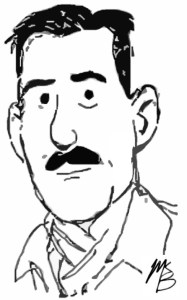
I have been pleased with your conduct during the last two very trying weeks, and can only say—keep it up. I don’t think it will be long now, and if you can maintain the spirit and esprit-de-corps that we have now–there is no doubt as to what will happen when we meet the enemy.
(Young address, War Diary, 23 Jun 1944)
Born in Toronto on 9 May 1905, Austin Moore Young was a businessman and insurance agent. In 1929, he qualified as a lieutenant in the Toronto Regiment, which became the Royal Regiment of Canada in 1936. Having completed a senior officer’s course, Young became second-in-command in September 1943. By the end of the year, he had succeeded Lieutenant-Colonel F.S. Wilder. For the next six months the regiment trained for the anticipated invasion of France and Young temporarily took over the 4th Infantry Brigade during absences of the brigadier.
After the D-Day landings of 6 June 1944, the Royal Regiment awaited their own orders to embark for the battlefield of Normandy. Young attempted to sustain the morale and enthusiasm of the restless troops:
Two weeks have gone by and we are still here. We must all understand that in an operation of the scope and magnitude of this kind, there are so many considerations affecting the time each unit may be called upon to play its part …
On 7 July 1944, the Royal Regiment along with the 2nd Division landed in France. The regimental newsletter, the Rumour, carried what would be the colonel’s final message to the troops a few days later:
The Battalion has at long last arrived in the theatre of War. After many months of hard training we are ready for the tasks which lie before us. It has been my privilege to be second in command and since January Commanding Officer of the Battalion during this period …
Remember you are playing your parts in the greatest battle in history. This Regiment has always had a reputation for doing the job at hand and doing it with every rifle, bayonet and gun operating at 100% efficiency. I know it will not be different in what for many of us will be our first battle. I am immensely proud to command the unit at this time—and know that you will do as good a job as ever, and the Hun will soon know to his sorrow that the Royals are here.
Young never had an opportunity to command his regiment in battle. Just a week after arriving in France, he was removed in favour of Major J.C.H. Anderson. According to historian Terry Copp, “Young proved unsuited for the stress of front line command and was replaced by his very able 2IC before the battalion’s first offensive operation.” By the end of the war Young served as administration officer for the Khaki University set up near Camberley, England.
He died in Goderich in May 1979.
 World War Graphic History