Lieutenant-Colonel Doug Catto
Royal Regiment of Canada
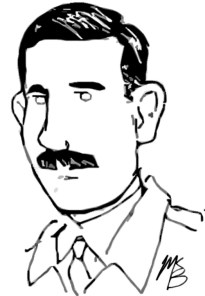
Colonel Catto did not overcome the shock of Dieppe. On his first action he lost his whole regiment in two hours. He saw that it was over, that there was nothing more to win. Still, he became the front fighter of his regiment. He was captured at the furthest forward position. I characterize this affair as the last knightly encounter with the enemy on the field of battle.
— Hauptmann Richard Schnosenberg
(Quoted in Whitaker, Dieppe: Tragedy to Triumph, 270)
Born in Toronto on 13 April 1899, Douglas Ellisson Catto was a First World War artillery gunner, University of Toronto graduate, and architect. As second-in-command of the Royal Regiment of Canada, he succeeded Lieutenant-Colonel G. Hedley Basher in July 1942. The next month, Catto led the regiment ashore in the failed Dieppe Raid of 19 August 1942. In initial reports after the battle the colonel was listed as missing and presumed killed in action.
Catto had in fact survived the decimation of his regiment but spent the next thirty-two months as a prisoner of war in Germany. Of over 550 Royal Regiment soldiers at Dieppe, just over sixty evacuated from the beach. When he had expressed concerns about the operation during planning phase, he had been reprimanded by a superior, “If you want to keep your command, keep your mouth shut.”
Although the first wave in the raid had been repulsed, Catto committed the second half of his battalion to try and salvage the situation on the beach. With his command virtually annihilated, Catto advanced with a band of twenty men before he realized surrender was the only option.
Catto along with fellow 4th Brigade colonels captured in the raid, Robert Labatt of the Royal Hamilton Light Infantry and Fred Jasperson of the Essex Scottish, were finally liberated by the US 3rd Army in May 1945.
He returned to his architect career in Toronto and served as honorary lieutenant-colonel of the Royal Regiment in the 1960s.
He died in Bracebridge, Ontario on 26 July 1973.
 World War Graphic History